_edited.png)

_edited.png)
Brand Clarity Drives 37% Higher Loyalty & Revenue Growth
- Feb 28
- 9 min read

Brands with clear, consistent messaging experience 23% higher revenue growth on average than those with unclear messaging. Yet many founders and marketing directors struggle with vague positioning that confuses customers and misaligns teams. This wastes budgets and stalls growth. This guide reveals how brand clarity solves these challenges, presenting proven frameworks, statistics, and case studies to help you build a focused brand that drives measurable results.
Table of Contents
Key Takeaways
Point | Details |
Brand clarity drives loyalty | Companies with high brand clarity see 37% higher customer loyalty through repeat purchases. |
ROI and growth accelerate | Clear messaging prevents up to 25% budget waste and boosts revenue growth by 23% on average. |
Internal alignment improves | Employees understanding brand clarity are 48% more engaged and aligned with goals. |
Four components matter most | Promise, customer understanding, consistent messaging, and team alignment form the clarity foundation. |
Continuous refinement required | Regular audits maintain clarity as markets and customer expectations evolve. |
Understanding Brand Clarity: Definition and Components
Brand clarity is the degree to which your promise, audience understanding, messaging, and internal alignment work together seamlessly. It goes beyond simplicity or clean design. True clarity means every stakeholder, from customers to employees, instantly grasps what you stand for and why it matters.
Many confuse brand clarity with brand awareness. Awareness measures how many people recognize your name. Clarity measures how well they understand your value. You can have high awareness but low clarity, which leads to confusion and weak conversions. The distinction matters because clarity drives trust and action, while awareness alone rarely converts.
Brand Clarity vs. Brand Awareness
Aspect | Brand Clarity | Brand Awareness |
Focus | Understanding and alignment | Recognition and recall |
Outcome | Trust, loyalty, action | Familiarity, exposure |
Measurement | Message comprehension, internal alignment scores | Reach, mentions, impressions |
Four core components create effective brand clarity. First, your brand promise defines the specific value you deliver and why customers choose you. Second, customer understanding means knowing your audience’s needs, challenges, and decision criteria deeply. Third, consistent messaging ensures every touchpoint reinforces the same story without contradicting signals. Fourth, internal alignment gets every team member on the same page about goals and positioning.
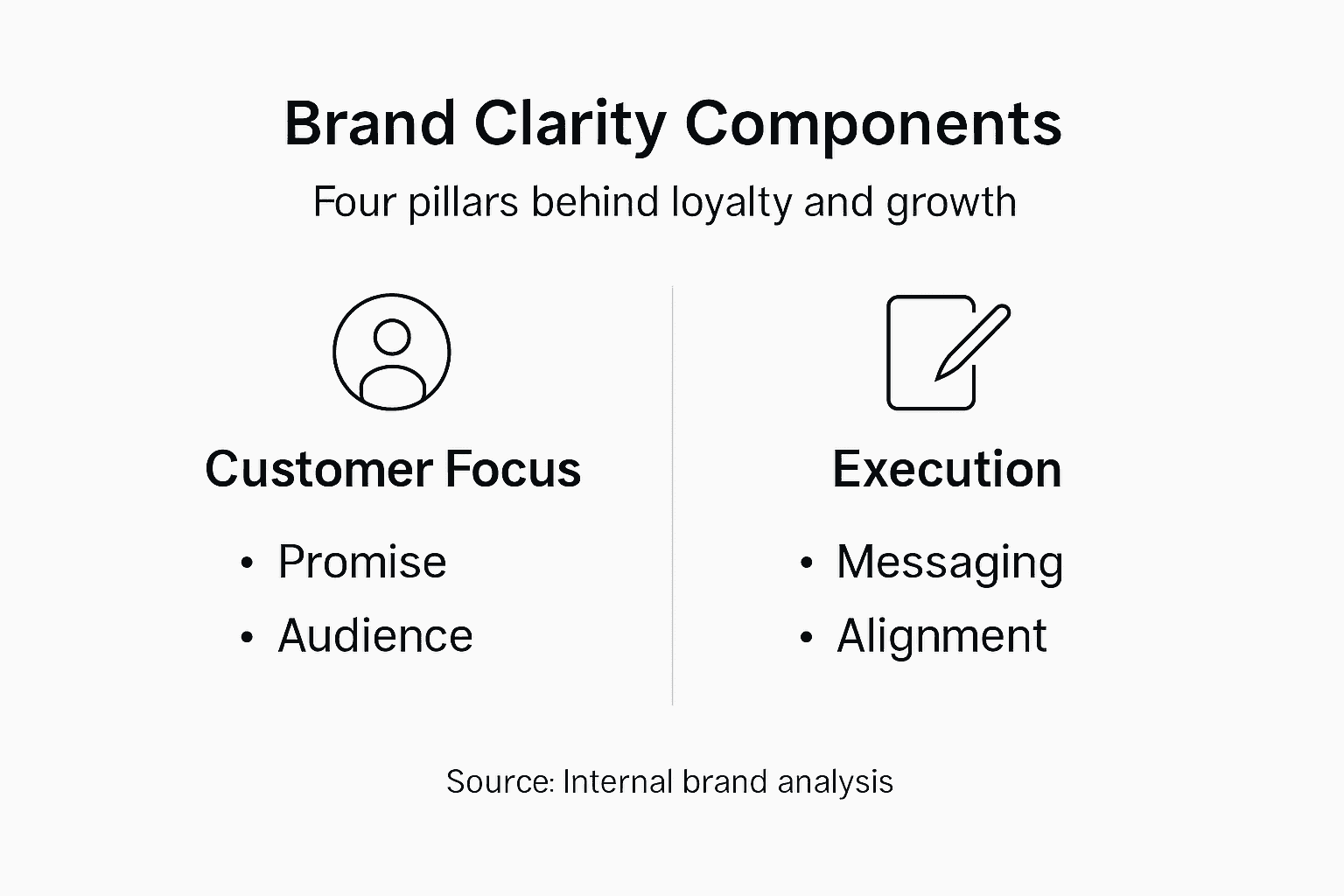
Without all four working together, gaps emerge. A strong promise means nothing if teams misunderstand it or customers never hear it consistently. Brand architecture and clarity structures these elements into a unified system. The importance of brand positioning becomes obvious when you see how it anchors the promise and messaging. Understanding brand strategy and growth reveals how clarity accelerates every stage of scaling.
Why Brand Clarity Drives Customer Trust and Recognition
Customers face endless choices and limited time. Clear branding cuts through noise by simplifying decisions. When your message instantly communicates who you serve and what problem you solve, prospects evaluate you faster. This speed reduces friction and increases conversion rates.
Research shows brands with high clarity outperform competitors by 37% in customer loyalty metrics, measured through repeat purchase rates. Loyalty stems from trust, and trust requires consistency. When customers experience the same clear message across ads, websites, emails, and support interactions, they feel confident in their choice. Inconsistent messaging raises doubts and triggers comparison shopping.
How clarity impacts customer behavior:
Simplifies initial purchase decisions by removing confusion about value and fit
Increases satisfaction because delivery matches the promise customers expected
Reduces churn by reinforcing the relationship through consistent post-sale communications
Generates referrals as satisfied customers clearly articulate your value to peers
Unclear branding does the opposite. Vague positioning forces customers to interpret your offer themselves. Misaligned messages create doubt. One study found unclear branding correlates with 19% higher customer churn in B2B service industries. Lost customers mean lost lifetime value and negative word of mouth.
Trust and recognition build momentum. Repeat buyers spend more and cost less to retain than new customer acquisition. Referrals arrive pre-sold because trusted sources explained your value clearly. The benefits of investing in brand clarity compound over time as trust deepens and recognition spreads organically.
Impact of Brand Clarity on Marketing ROI and Business Growth
Marketing efficiency suffers when brand messaging lacks clarity. Campaigns with inconsistent positioning dilute impact and waste spend testing unclear angles. Research indicates inconsistent messaging wastes up to 25% of marketing budgets through redundant creative development and underperforming campaigns.
Companies that refine brand clarity experience measurable growth acceleration. Internal analysis shows brands with clear, consistent messaging achieve 23% higher revenue growth on average compared to unclear competitors. This advantage stems from better campaign performance, higher conversion rates, and stronger customer retention.
Consider a mid-sized SaaS company that redefined its brand promise from generic productivity software to workflow automation for remote teams. Within six months, campaign conversion rates improved 34%, cost per lead dropped 28%, and customer acquisition cost fell proportionally. The clarity let marketing focus resources on high-converting channels and messages.
Implementing brand clarity improvements in marketing:
Audit current messaging across all channels to identify inconsistencies and vague claims.
Define a single core promise and supporting proof points that differentiate your value.
Align all creative assets, ad copy, landing pages, and email sequences to reinforce the promise.
Train marketing and sales teams on the refined positioning to ensure consistent delivery.
Measure performance metrics before and after to quantify clarity’s ROI impact.
Pro Tip: Establish a quarterly brand clarity scorecard tracking message consistency, campaign efficiency, and customer feedback. Monitor how clarity improvements correlate with conversion rates and customer lifetime value. This data justifies continued investment and identifies areas needing refinement.
Creative marketing processes that leverage clarity produce stronger campaigns faster. Marketing planning and brand clarity integration ensures strategy and execution align from the start.
Relationship Between Brand Clarity and Internal Team Alignment
External clarity starts internally. Employees who understand your brand clearly are 48% more likely to be engaged and aligned with business objectives. This engagement translates to better execution, fewer missteps, and unified goal pursuit across departments.

When teams grasp the brand promise and positioning, they make decisions consistent with strategic direction. Sales reps pitch the right value to the right prospects. Customer support reinforces brand promises during interactions. Product teams prioritize features that strengthen positioning. Marketing creates campaigns that resonate because everyone shares the same understanding.
Unclear internal brand understanding creates silos and miscommunication. Marketing launches campaigns sales can’t support. Product builds features that don’t align with positioning. Support makes promises the company can’t keep. These disconnects frustrate customers and waste resources.
Common internal challenges fixed by brand clarity:
Siloed departments working toward conflicting goals or using different messaging
New hires struggling to understand company direction and value proposition
Leadership debates stalling decisions because no shared strategic framework exists
Inconsistent customer experiences as different teams interpret brand differently
Pro Tip: Conduct monthly brand alignment sessions where teams share how they’re applying brand clarity in their work. Use real examples of customer interactions, campaign results, and product decisions. This reinforces understanding and surfaces opportunities to tighten alignment further.
The benefits of brand clarity on teams and growth multiply as alignment improves. Engaged teams execute faster, adapt better, and deliver consistent customer value.
Common Misconceptions About Brand Clarity
Many believe brand clarity simply means making things simpler or stripping away complexity. This misses the point. Clarity means communicating complex value in ways audiences instantly grasp. Apple’s products are sophisticated, but their brand clarity makes the value obvious. Simplicity without strategic focus creates bland, forgettable brands.
Another misconception treats brand clarity as purely external marketing work. In reality, internal clarity matters equally. Your team must understand and embody the brand before customers ever will. Skipping internal alignment produces hollow external messaging that rings false when customers interact with your company.
Some confuse brand clarity with brand awareness, believing more exposure automatically creates understanding. High awareness with low clarity just spreads confusion faster. You need both, but clarity must come first. Otherwise, you’re investing in making a vague message famous.
Why these misconceptions harm strategy:
Treating clarity as simplification alone strips away differentiating nuance and depth
Ignoring internal clarity leads to inconsistent customer experiences across touchpoints
Prioritizing awareness over clarity wastes budgets on messages that don’t convert
Confusing the two metrics causes companies to measure the wrong success indicators
Understanding these distinctions lets you invest resources correctly. Essential branding tips and misconceptions provides deeper guidance on avoiding these strategic errors.
Frameworks and Models for Achieving Brand Clarity
Achieving brand clarity requires a structured approach connecting all four core components. Start with the four-component framework: define your promise, understand your customers, unify messaging, and align internal teams. Each component reinforces the others.
Brand Clarity Assessment
Criteria | Clear Brand | Unclear Brand |
Promise Definition | Specific, differentiated, deliverable | Vague, generic, aspirational |
Customer Understanding | Deep insight into needs and decision drivers | Surface assumptions, no validation |
Message Consistency | Unified across all touchpoints | Contradictory signals, fragmented |
Internal Alignment | Teams execute with shared understanding | Silos, conflicting interpretations |
Steps to implement brand clarity:
Define your brand promise by identifying the specific outcome customers achieve and why your approach works better than alternatives.
Conduct customer research through interviews, surveys, and journey mapping to validate assumptions about needs and language.
Unify messaging by creating a messaging hierarchy with core promise, supporting pillars, and proof points used consistently.
Align teams internally through workshops, documentation, and regular reinforcement of positioning and strategy.
Measure and refine using customer feedback, conversion data, and team alignment scores to identify clarity gaps.
Pro Tip: Treat brand clarity as an ongoing practice, not a one-time project. Markets shift, customer needs evolve, and competitors reposition. Schedule quarterly clarity audits reviewing messaging consistency, customer perception data, and internal alignment surveys. Adjust positioning iteratively based on what you learn.
Brand management fundamentals provides additional frameworks for maintaining clarity as you scale.
Case Studies Illustrating Brand Clarity Success
A mid-sized technology consultancy struggled with generic positioning as “IT solutions provider.” Marketing campaigns underperformed, sales cycles stretched long, and employee turnover ran high. Leadership refined brand clarity around a specific promise: securing cloud infrastructure for healthcare companies navigating compliance.
Within eight months, results shifted dramatically. Revenue grew 29% year over year, exceeding the 23% industry benchmark for clear brands. Customer retention improved from 68% to 84% as the focused promise attracted better-fit clients. Marketing cost per lead dropped 31% because targeting became precise.
Employee engagement surveys showed 52% improvement in team alignment scores. Sales reps closed deals faster because they clearly articulated unique value. Support tickets decreased as customers understood exactly what the company delivered. The focused positioning also attracted talent seeking healthcare security expertise.
Key lessons for founders and marketing directors:
Specific beats generic: narrow your promise to a defined audience and outcome
Measure clarity impact: track conversion rates, customer retention, and team alignment before and after
Invest in internal rollout: clarity only works when teams understand and execute consistently
Refine based on feedback: use customer and employee input to tighten positioning over time
Examples of effective branding for strategic growth showcases additional case studies demonstrating clarity’s competitive advantage.
Unlock Growth with Expert Brand Clarity Solutions
Building brand clarity requires strategic frameworks, customer insight, and execution discipline. If your messaging feels scattered or your teams seem misaligned, expert guidance accelerates progress. Explore proven approaches to brand strategy and growth that connect clarity to measurable business outcomes.

Discover essential marketing strategy tips designed for growth leaders facing positioning challenges. Learn how a structured marketing positioning workflow transforms vague ideas into focused brand clarity that drives customer loyalty and revenue growth.
Frequently Asked Questions About Brand Clarity
How do you measure brand clarity in practical terms?
Measure clarity through customer comprehension surveys asking them to describe your value in their own words, then compare responses to your intended message. Track internal alignment with employee surveys rating their understanding of brand promise and positioning. Monitor conversion rates and customer acquisition costs as lagging indicators of external clarity.
How often should brand clarity be reviewed or updated?
Conduct quarterly reviews of messaging consistency and customer feedback to catch drift early. Perform comprehensive brand clarity audits annually or when major market shifts occur, such as entering new segments or facing new competitive threats. Rapid growth phases require more frequent checks to maintain alignment as teams scale.
What are quick ways to align teams with the brand promise?
Host focused workshops where teams practice articulating the brand promise and discuss real customer scenarios. Create simple one-page brand briefs everyone can reference during daily work. Use real customer success stories in team meetings to reinforce how the promise plays out in practice.
How do you maintain brand clarity during rapid growth?
Document positioning, messaging, and decision frameworks before scaling so new hires learn consistent brand understanding. Build brand clarity checkpoints into onboarding for every role. Assign brand stewards in each department who monitor consistency and flag misalignment quickly.
What first steps should you take if brand messaging feels inconsistent?
Audit all customer-facing content to catalog current messages and identify contradictions. Interview sales, support, and marketing teams to understand how they each describe your value. Compare findings against your intended positioning, then prioritize closing the biggest gaps through updated messaging guides and team training.
Recommended

Comments