


_edited.png)
Marketing Planning Workflow for Successful Campaigns
- Feb 25
- 9 min read

Launching a marketing campaign without clear goals and audience understanding feels like navigating Toronto during rush hour with no map. This is why assessing your objectives and pinpointing your ideal client is the foundation of smart marketing. When you commit to collecting quality customer data, you build campaigns that actually resonate and drive measurable results. Discover how a step-by-step workflow transforms aimless tactics into focused action for consistent growth.
Table of Contents
Quick Summary
Key Insight | Explanation |
1. Define Clear Business Goals | Establish precise business goals to guide your marketing strategy, avoiding vague aspirations that lead to confusion. |
2. Identify Your Target Audience | Create specific profiles of your ideal clients based on their demographics and behaviors to tailor your messaging effectively. |
3. Set Measurable Marketing Objectives | Transform goals into measurable, actionable objectives to track the success of your marketing campaigns over time. |
4. Develop a Cohesive Strategy | Ensure your marketing strategy connects messaging, channels, and tactics to work towards your established objectives seamlessly. |
5. Implement Regular Review Cycles | Conduct monthly or quarterly performance reviews to analyze results, optimize strategies, and ensure continuous improvement in marketing efforts. |
Step 1: Assess business goals and target audience
Before you launch any marketing campaign, you need clarity on two critical things: what your business actually wants to achieve and who you’re trying to reach. Without both, you’re shooting in the dark. This assessment forms the foundation for every decision that follows.
Start by defining your business goals with precision. Are you trying to increase revenue, build brand awareness, generate leads, or establish thought leadership in your field? For professional service firms in Toronto, goals often center on attracting high-value clients or expanding into new service lines. Write these goals down clearly. Vague aspirations won’t cut it.
Next, you’ll want to align these goals with your marketing objectives to ensure everything moves in the same direction. This alignment prevents scattered efforts and keeps your team focused.
Now shift to your target audience. This isn’t just “everyone who needs our services.” You need specifics. Collecting quality customer data about demographics, behavior, and motivations helps you understand who you’re actually talking to.
Create a profile for your ideal client by answering these questions:
What industry or company size do they work in?
What challenges keep them awake at night?
How do they prefer to learn about solutions?
What budget authority do they have?
Where do they consume content (LinkedIn, industry forums, trade publications)?
For professional services, your target audience likely includes decision-makers and gatekeepers. Understand their priorities, pain points, and what success looks like to them. This insight directly shapes your messaging and campaign strategy.
Document both your business goals and audience profiles in one place. You’ll reference these constantly throughout your planning process. This groundwork transforms vague ideas into actionable direction.
Strong goals and clear audience definition eliminate guesswork from your entire marketing strategy and keep campaigns focused on what actually matters to your business.
Step 2: Define measurable marketing objectives
Now that you know what your business wants and who you’re targeting, it’s time to translate those aspirations into measurable objectives. This is where vague goals become concrete, trackable metrics that actually tell you whether your campaigns are working.
The difference between goals and objectives matters. Your goal might be “grow revenue.” Your objective is “generate 50 qualified leads per month from LinkedIn” or “increase website traffic by 25% in the next quarter.” One is aspirational, the other is actionable.
Start by identifying metrics that align with your business outcomes. For professional service firms, this often means tracking lead quality, conversion rates, and deal size rather than just volume. What specific outcomes move your business forward?
Set objectives using this framework:
Make them specific (not “get more leads,” but “acquire 40 qualified prospects in commercial law”)
Make them measurable (use numbers, percentages, and timelines)
Make them realistic (based on your resources and market conditions)
Make them tied to business results (revenue impact, client retention, market share)
Each objective should have a clear success metric attached to it. If your objective is brand awareness, measure it through website traffic, impressions, or brand recall surveys. If it’s lead generation, track form submissions and cost per lead. These metrics become your scoreboard.
With objectives defined, your whole team knows what winning looks like. Marketing can align tactics to these targets, and you can track progress regularly. This clarity transforms marketing from a cost center into a measurable growth driver.
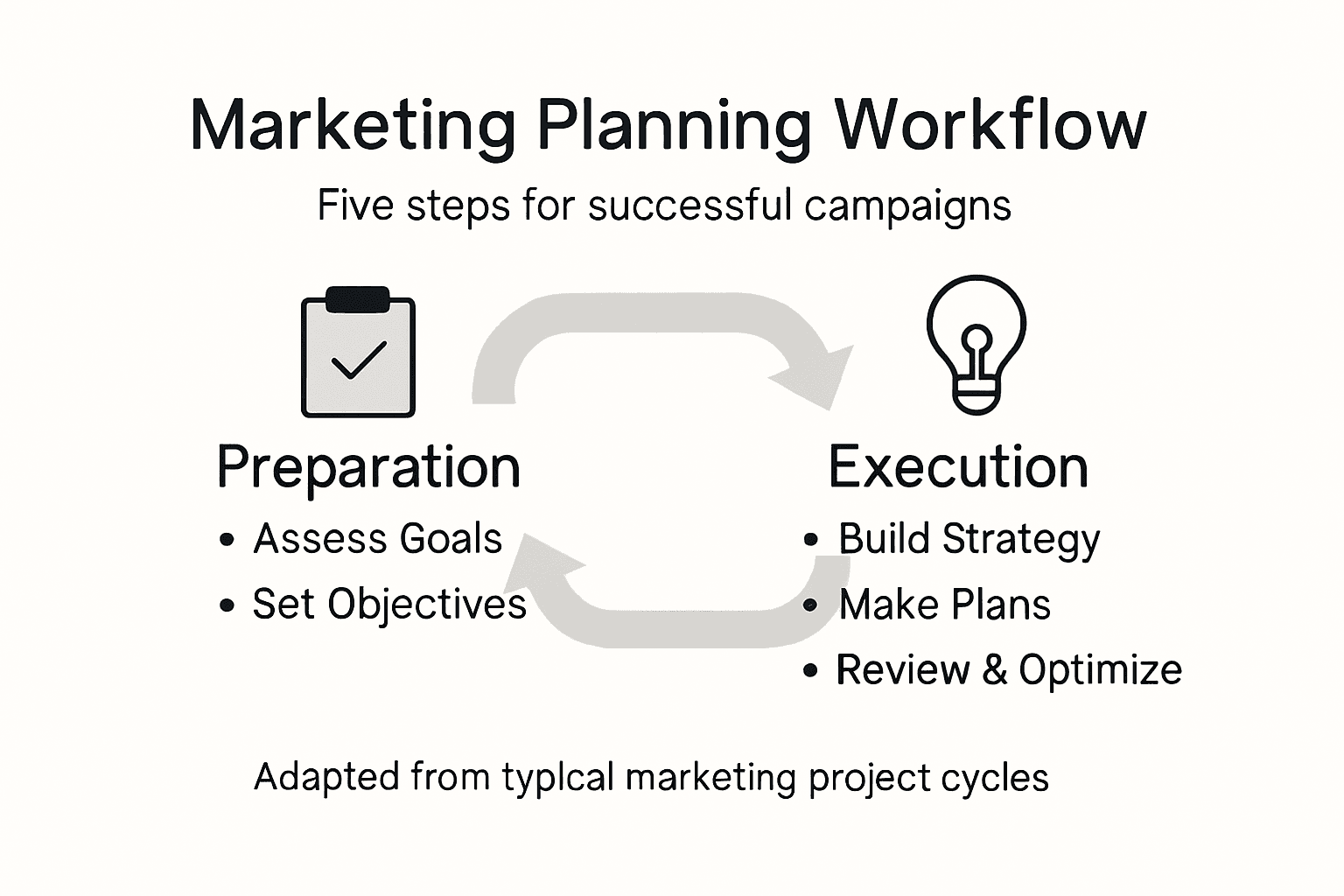
Here’s a summary of how strategic marketing goals, objectives, and strategies interact:
Aspect | Purpose | Example | Business Impact |
Goal | High-level aspiration | Increase market share | Sets long-term direction |
Objective | Measurable target | Add 50 clients this year | Enables tracking progress |
Strategy | Method to achieve objectives | Launch LinkedIn campaigns | Guides tactical execution |
Clear, measurable objectives eliminate ambiguity about what success means and give your team concrete targets to work toward each month.
Step 3: Design cohesive marketing strategies
Your goals and objectives are locked in. Now comes the strategy itself, the blueprint that holds everything together. A cohesive marketing strategy connects your messaging, channels, and tactics so they all work toward the same destination.

Think of strategy as your answer to “how will we get there?” Your objectives said what you want to achieve. Strategy says which routes you’ll take and why. A cohesive strategy means every piece fits together and reinforces the others instead of working in isolation.
Start by defining brand positioning and messaging that resonates with your target audience. For professional services, this means clarifying what makes your firm different. Are you the responsive boutique? The specialized expert? The trusted advisor? Lock this down because everything else flows from it.
Next, map your channel strategy. Where does your audience actually engage? Professional service firm decision-makers might hang out on LinkedIn, read industry publications, or attend conferences. Some may respond to email outreach. Others prefer content on your website. Choose channels based on data, not guesswork.
Your strategy should address these elements:
Brand positioning (what you stand for and why you matter)
Key messaging (the core points you want prospects to remember)
Channel strategy (where and how you’ll reach your audience)
Content approach (what types of content serve each stage of the buyer journey)
Competitive differentiation (why prospects choose you over alternatives)
A strategy also accounts for your resources and timeline. You won’t execute everything at once. Prioritize based on what drives your measurable objectives. Build flexibility in so you can adapt as you learn what’s working.
When your strategy is cohesive, your team speaks with one voice. Marketing and sales alignment becomes easier. Every campaign reinforces your positioning instead of contradicting it.
A coherent strategy eliminates scattered efforts and ensures every marketing action moves you closer to your business objectives.
Step 4: Develop actionable implementation plans
Strategy is the map. An implementation plan is the turn-by-turn directions that actually get your team moving. Without it, even brilliant strategy sits on a shelf collecting dust while your team wonders what to do next.
An actionable plan turns your strategy into specific campaigns, tasks, and timelines. It answers the questions your team will inevitably ask: What exactly are we doing? Who owns it? When does it happen? How much budget do we have? This clarity prevents confusion and keeps everyone aligned.
Start by defining specific campaigns and action steps derived from your strategy. If your strategy says “build thought leadership through content,” your implementation plan specifies which content pieces, which topics, who writes them, and when they publish. Vague goals create vague execution.
Your implementation plan should include:
Specific campaigns (webinar series, email nurture sequence, LinkedIn content calendar)
Timeline and deadlines (when each piece launches and completes)
Assigned ownership (who’s responsible for each task)
Budget allocation (what each campaign costs)
Success metrics (how you’ll measure if it worked)
Review checkpoints (when you evaluate progress and adjust)
Break larger campaigns into smaller, manageable tasks. Instead of “launch content marketing program,” write “publish 4 blog posts monthly, schedule 8 LinkedIn articles, create 1 case study.” Specificity drives execution.
Assign clear ownership. Campaigns fail when “someone” is responsible. Name a campaign owner who drives execution and reports on progress. This person isn’t working alone, but they’re the quarterback ensuring momentum.
Build in review points monthly or quarterly to check progress against your metrics. Did that webinar series generate the leads you expected? Did content drive website traffic? Use this data to optimize and adjust. Your plan isn’t carved in stone.
A solid implementation plan bridges the gap between “here’s our strategy” and “here’s what we’re doing this week.” It gives your team something concrete to execute and gives you visibility into progress.
Detailed action plans with clear ownership and timelines transform strategy into consistent, measurable marketing progress that compounds over months.
Step 5: Review outcomes and optimize workflow
Your campaigns are running. Now comes the part that separates good marketing teams from great ones: looking at what actually happened and learning from it. Review and optimization transform one-time successes into repeatable systems.
Don’t wait until the end of the year to check results. You need regular review cycles to see what’s working while you still have time to adjust. Monthly or quarterly reviews keep you nimble instead of locked into a plan that’s underperforming.
Start by analyzing performance data against your objectives. Pull your key performance indicators for each campaign. Did that LinkedIn content strategy generate the qualified leads you targeted? How many website visitors converted to contacts? What was your actual cost per lead versus your goal?
Compare results to your predefined metrics:
Did you hit your lead volume targets?
What was the quality of leads generated?
Which channels delivered the best return on investment?
What content resonated most with your audience?
Where did prospects drop off in the buyer journey?
Identify both wins and gaps. Maybe your webinar series crushed expectations while your email campaigns underperformed. Celebrate the wins, then investigate the gaps. Why did email struggle? Wrong audience? Poor timing? Weak subject lines? Specific answers fuel better decisions.
Use these insights to optimize your workflow. If LinkedIn outperformed other channels, reallocate budget there. If certain content topics drive more engagement, create more of it. If your sales team receives poor-quality leads, refine your targeting. Optimization is data-driven, not guesswork.
Document what you learned. Over time, these insights become your marketing playbook. You’ll know which campaigns work for your firm, which channels reach decision-makers, and what messaging resonates. This institutional knowledge compounds with every review cycle.
Schedule your next review before the current period ends. Consistency in reviewing outcomes builds momentum for continuous improvement.
This table highlights key differences between proactive and reactive marketing workflows:
Workflow Type | Approach | Review Frequency | Typical Outcome |
Proactive | Planned and scheduled | Monthly/quarterly reviews | Continuous improvement |
Reactive | Responds to issues as they arise | Irregular or ad hoc | Short-term fixes, less learning |
Regular outcome reviews with honest analysis reveal what’s working, expose gaps early, and transform scattered efforts into a high-performing marketing system.
Transform Your Marketing Planning Into Measurable Success
Many businesses struggle to turn broad goals into clear, trackable marketing plans that deliver real growth. If you find yourself challenged by vague objectives or fragmented strategies that fail to move the needle, you are not alone. This article highlights crucial steps like defining measurable marketing objectives, creating cohesive strategies, and developing detailed implementation plans to eliminate guesswork and achieve consistent progress.
At Unnamed Marketing Company, we understand the emotional strain that comes with unclear direction and scattered efforts. Our strategic growth and brand consultancy specializes in bridging that gap by aligning your business goals with actionable marketing frameworks designed to perform. With our expertise in Digital Products, we can help you craft comprehensive campaigns that resonate with your target audience and produce measurable outcomes.

Ready to stop guessing and start growing with intention? Visit Unnamed Marketing Company to discover how our proven marketing planning solutions turn your strategy into consistent, scalable results. Take the next step today and experience the power of marketing built around your business goals.
Frequently Asked Questions
How do I assess my business goals for marketing?
Start by clearly defining what you want to achieve, such as increasing revenue or generating leads. Write down specific goals to avoid vague aspirations and ensure your marketing efforts are aligned with your business objectives.
What metrics should I use to measure my marketing objectives?
Use specific, measurable metrics that align with your business outcomes, like lead quality and conversion rates. For example, aim to generate 50 qualified leads per month from your campaigns to track progress effectively.
What should I include in my marketing strategy?
Your marketing strategy should define your brand positioning, key messaging, channel strategy, and content approach. Ensure all elements work together cohesively to achieve your set objectives effectively.
How do I create an actionable implementation plan for my marketing strategy?
Break down your marketing strategy into specific campaigns, tasks, and timelines. Assign ownership for each task, set deadlines, and establish success metrics to guide your team’s execution and track progress.
How often should I review my marketing outcomes?
Conduct regular reviews monthly or quarterly to analyze your campaign performance against predefined metrics. This consistent check will help you identify wins and areas for improvement to optimize your marketing efforts.
What is the importance of documenting lessons learned from my marketing campaigns?
Documenting lessons learned helps create a marketing playbook that informs future campaigns. This continuous learning process enables your team to replicate successful strategies and avoid past mistakes, ultimately improving overall performance.
Recommended

Comments