


_edited.png)
Creative Marketing Process for Powerful Brand Growth
- Feb 15
- 8 min read

Standing out in the crowded Canadian and American markets can feel nearly impossible when service offerings seem interchangeable. For marketing directors at growing Toronto firms, the real challenge is defining a brand identity that both resonates deeply with clients and secures a competitive advantage. By focusing on a clear strategic framework rooted in research and authentic insights, you can shape market perceptions and create lasting value for your firm on both sides of the border.
Table of Contents
Quick Summary
Important Insight | Explanation |
1. Define Unique Brand Identity | Develop a clear and distinct brand identity that resonates with your target audience and highlights your unique value proposition. |
2. Conduct Comprehensive Research | Utilize diverse methodologies to gather deep insights about customer preferences and market trends beyond basic demographics. |
3. Create Engaging Narratives | Transform strategic insights into compelling brand narratives and concepts that emotionally connect with your audience. |
4. Execute Multichannel Campaigns | Implement a cohesive marketing strategy that ensures consistent messaging and customer experiences across various channels. |
5. Measure and Optimize Performance | Regularly evaluate campaign effectiveness using key performance indicators to refine strategies and improve results. |
Step 1: Define strategic brand positioning goals
Defining strategic brand positioning goals is about creating a clear, compelling roadmap that distinguishes your brand in a competitive marketplace. Your objective is to craft a distinctive identity that resonates with your target audience and communicates your unique value proposition.
The process begins with comprehensive market research to understand your competitive landscape. Strategic brand positioning methodology requires deep analysis of several critical components:
Customer preferences and pain points
Competitor positioning strategies
Your brand’s core strengths and differentiators
Current market opportunities
To develop a powerful positioning strategy, you’ll need to answer fundamental questions about your brand:
What makes your brand truly unique?
Who are your ideal target customers?
What specific problems do you solve better than anyone else?
What emotional and rational benefits do you provide?
Successful brand positioning requires aligning your internal capabilities with external market expectations. By creating a clear strategic framework, you transform your brand from a generic offering into a compelling market solution.
Strategic brand positioning is not about being everything to everyone, but about being the perfect solution for someone specific.
Document your positioning statement as a concise, memorable declaration that captures your brand’s essence. This statement will guide all future marketing communications and strategic decisions.
Pro tip: Validate your brand positioning with actual customer feedback and be prepared to iterate based on market responses.
Step 2: Research audience insights and trends
Researching audience insights and trends is a critical foundation for developing a powerful marketing strategy that connects with your target market. Your goal is to uncover deep, actionable intelligence about your potential customers, their behaviors, preferences, and emerging market dynamics.
Start by leveraging comprehensive research methodologies that go beyond surface-level demographic data. This involves multiple strategic approaches:
Conducting online and offline surveys
Analyzing social media sentiment
Reviewing industry reports and publications
Interviewing current and potential customers
Tracking digital engagement metrics
Key research dimensions to explore include:
Demographic characteristics
Psychographic profiles
Purchase behavior patterns
Technology adoption rates
Emerging market challenges
Data collection methods should be diverse and comprehensive. Combine quantitative research (statistical data) with qualitative insights (personal interviews, focus groups) to develop a nuanced understanding of your audience.

Compare the benefits of quantitative vs. qualitative research methods:
Method Type | Key Advantage | Limitation | Best Used For |
Quantitative | Provides statistical trends | May lack depth | Measuring large-scale patterns |
Qualitative | Reveals human motivations | Harder to generalize results | Understanding behaviors and attitudes |
Real market intelligence is not about collecting data, but interpreting human behavior and motivation.
Utilize advanced analytics tools to transform raw data into meaningful strategic insights. Look for patterns, contradictions, and unexpected trends that can inform your brand positioning and marketing approach.
Pro tip: Cross-reference multiple data sources to validate your insights and avoid drawing conclusions from limited or biased information.
Step 3: Develop compelling creative concepts
Developing compelling creative concepts is about transforming your strategic insights into powerful visual and narrative expressions that capture your brand’s unique essence. This step bridges the gap between strategic research and creative execution, turning audience understanding into memorable brand experiences.
Start by crafting engaging brand narratives that authentically represent your brand’s core values and resonate with your target audience. Your creative development process should incorporate multiple strategic approaches:
Brainstorm multiple concept directions
Create mood boards and visual references
Develop initial concept sketches
Test concepts against audience personas
Validate emotional and rational appeal
Key elements of compelling creative concepts include:
Clear communication of brand values
Emotional connection with target audience
Distinctive visual and narrative style
Alignment with brand positioning
Potential for multi-channel adaptation
Creative ideation requires a balance between strategic thinking and imaginative exploration. Challenge your team to move beyond conventional approaches and develop concepts that surprise and engage your audience.
Great creative concepts are not about being different, but about being meaningfully unique.
Ensure your creative concepts are flexible enough to work across various marketing channels while maintaining a consistent brand identity. Test and refine your concepts through iterative feedback and audience validation.
Pro tip: Always maintain a connection between your creative concept and the core strategic insights that inspired it.
Step 4: Activate multichannel campaign execution
Activating multichannel campaign execution transforms your creative concepts into a synchronized marketing strategy that reaches your audience through multiple touchpoints. Your goal is to create a cohesive brand experience that connects with customers across different platforms and communication channels.
Implement comprehensive multichannel marketing strategies that ensure consistent messaging and seamless customer interactions. Your campaign activation should include:
Digital platform alignment
Content adaptation for each channel
Integrated messaging framework
Cross-channel performance tracking
Audience engagement optimization
Key execution strategies include:
Develop platform-specific content variations
Establish consistent brand voice across channels
Create interconnected storytelling experiences
Implement robust tracking mechanisms
Design flexible content templates
Campaign coordination requires meticulous planning and precise execution. Each channel should reinforce your core brand message while maintaining its unique communication style and audience expectations.
Successful multichannel marketing is about creating a unified narrative, not just repeating the same message everywhere.
Utilize advanced analytics to monitor campaign performance, making real-time adjustments to optimize audience engagement and maximize your marketing impact.
Pro tip: Design your content with built-in flexibility to allow quick adaptation across different marketing channels.
Step 5: Measure results and refine the process
Measuring results and refining your marketing process transforms raw data into strategic insights that drive continuous improvement. Your goal is to systematically evaluate campaign performance, identify strengths and weaknesses, and create an adaptive marketing strategy that evolves with your business objectives.
Utilize comprehensive marketing effectiveness strategies that provide actionable intelligence about your campaign performance. Your measurement approach should encompass multiple analytical dimensions:
Quantitative performance metrics
Qualitative audience feedback
Comparative channel analysis
Return on investment calculations
Benchmarking against industry standards
Key measurement techniques include:
Define clear, measurable objectives
Select relevant performance indicators
Establish baseline performance metrics
Track real-time campaign data
Conduct periodic comprehensive reviews
Data-driven refinement requires a disciplined and objective approach. Analyze your metrics not just for reporting, but as a strategic tool for continuous marketing optimization.
Effective measurement is less about proving performance and more about improving future strategies.
Implement a systematic review process that transforms insights into actionable improvements, ensuring your marketing approach remains dynamic and responsive to changing market conditions.
Pro tip: Create a standardized measurement dashboard that allows quick visualization of key performance indicators across all marketing channels.
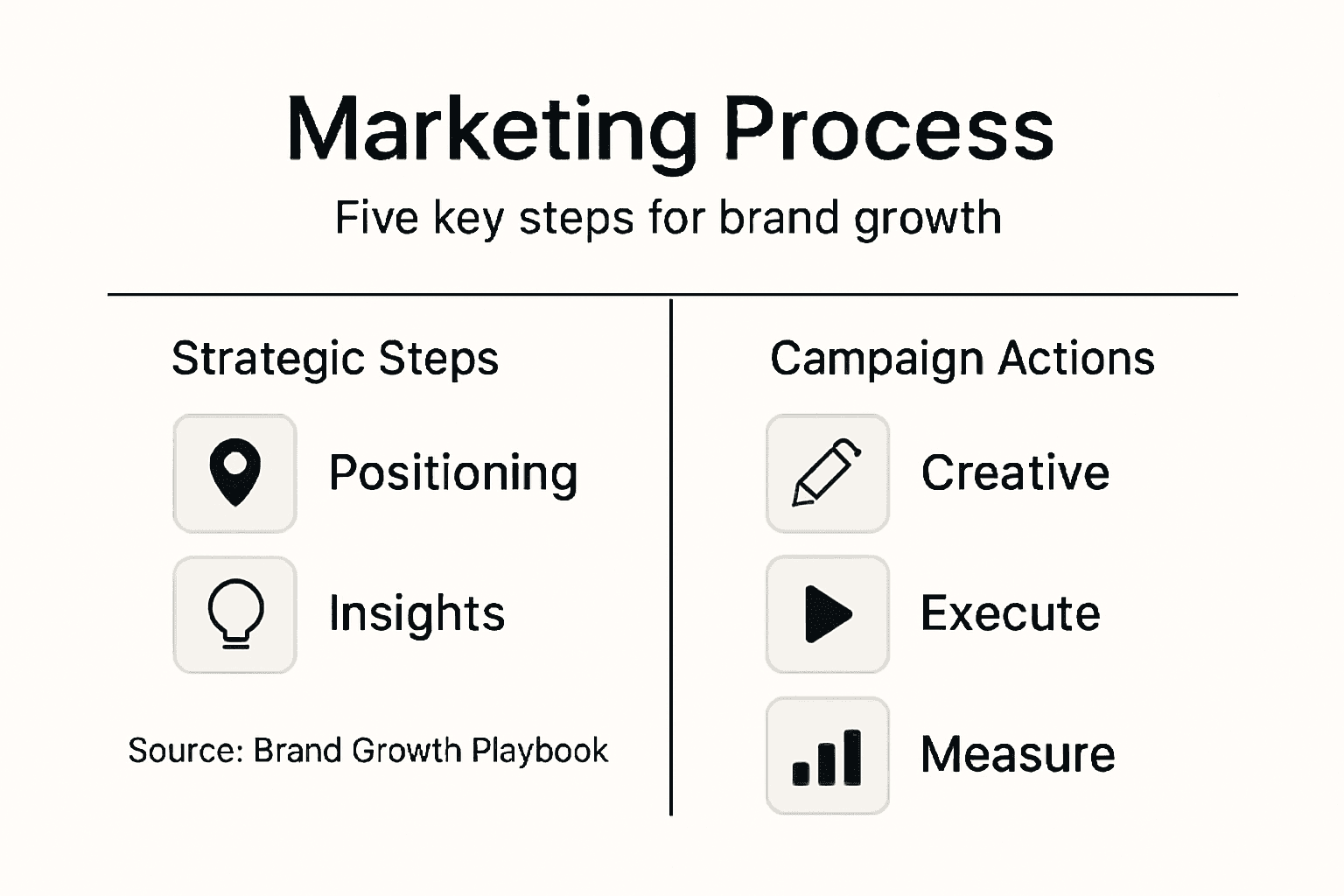
Here’s how each step contributes to an effective brand strategy:
Step | Main Focus | Typical Tools Used | Success Indicator |
Brand Positioning | Unique market identity | Market research, SWOT analysis | Clear positioning statement |
Audience Insights | Deep customer understanding | Surveys, analytics, interviews | Defined customer segments |
Creative Concepts | Memorable brand narratives | Mood boards, sketches, testing | Strong audience resonance |
Multichannel Execution | Consistent messaging everywhere | Cross-platform tools, templates | Synchronized campaign delivery |
Measurement & Refinement | Ongoing improvement | Dashboards, KPIs, benchmarking | Enhanced campaign ROI |
Unlock Your Brand’s Full Potential with Expert Strategic Support
The “Creative Marketing Process for Powerful Brand Growth” article highlights the challenge of bridging strategic planning with effective execution to build a unique and memorable brand. Key goals include defining clear brand positioning, developing audience insights, and activating multichannel campaigns that truly resonate. We understand that turning these complex steps into real-world results can feel overwhelming without the right guidance. That is why at Unnamed Marketing Company we combine strategy creativity and performance to help you plan position and scale with intention. Our proven frameworks focus on aligning your internal strengths with market opportunities to create brand narratives and campaigns that engage your ideal customers at every touchpoint.
If you are ready to transform your marketing strategy into measurable growth start by exploring our Digital Products | Unnamed Marketing Company designed to support every stage of brand development and campaign execution.

Experience the difference of a partner who understands how to turn research insights into compelling creative concepts and bring them to life through integrated multichannel activation. Visit Unnamed Marketing Company now to discover how we help businesses just like yours unlock strategic clarity and accelerate powerful brand growth. Take the first step toward a stronger brand and better results today.
Frequently Asked Questions
What are the first steps in the creative marketing process for brand growth?
To begin the creative marketing process, define your brand positioning goals and conduct market research to understand your audience and competitive landscape. Start your brand strategy by clearly documenting what makes your brand unique and identifying your ideal target customers.
How can I gather audience insights to inform my marketing strategy?
Gather audience insights by using a mix of quantitative and qualitative research methods, such as surveys, social media analysis, and customer interviews. Aim to collect data within 30 days to quickly begin shaping your marketing approach.
What makes a compelling creative concept for a brand?
A compelling creative concept should clearly communicate your brand values, foster an emotional connection with your audience, and maintain alignment with your brand positioning. Brainstorm multiple ideas and test their appeal through audience feedback to refine your concepts.
How do I ensure consistent messaging across multiple marketing channels?
To achieve consistent messaging across channels, develop platform-specific content that aligns with your overall brand voice and narrative. Create a content template that highlights your core message to ensure it is effectively communicated everywhere within your campaign.
What metrics should I use to measure the effectiveness of my marketing campaigns?
Utilize both quantitative metrics, such as engagement rates and sales conversions, and qualitative feedback from customers to measure campaign effectiveness. Set clear objectives and track these metrics regularly to identify areas for improvement and optimize future campaigns.
How can I refine my marketing strategy based on campaign performance?
Refine your marketing strategy by analyzing your performance metrics to identify strengths and weaknesses in each campaign. Conduct periodic reviews and make data-driven adjustments to enhance your approach, ideally within a month of executing each campaign.
Recommended

Comments