


_edited.png)
How to Align Marketing Goals for Strategic Business Growth
- Feb 15
- 7 min read

Setting marketing goals that actually accelerate company growth can often feel complicated for leaders at North American technology firms. The path starts with defining clear business objectives and aligning marketing metrics that truly matter. When strategic goal alignment directly impacts performance, the ability to map measurable goals to actionable Key Performance Indicators becomes a crucial advantage. Gain practical strategies to ensure your marketing plans are always in sync with your firm’s evolving objectives.
Table of Contents
Quick Summary
Important Insight | Explanation |
1. Define Clear Objectives | Establish specific, measurable goals aligned with your organization’s mission for effective marketing strategies. |
2. Assess Current Performance | Conduct a comprehensive evaluation of existing marketing efforts to identify strengths and areas for improvement. |
3. Set SMART Goals | Create marketing goals that are Specific, Measurable, Achievable, Relevant, and Time-bound for actionable results. |
4. Map Goals to KPIs | Connect each marketing goal to relevant Key Performance Indicators for ongoing performance tracking and adjustments. |
5. Monitor and Adjust Strategies | Continuously review marketing metrics and adapt strategies based on real-time insights for effective growth. |
Step 1: Define Business Objectives for Alignment
Defining clear business objectives is the foundational step in creating a strategic marketing roadmap that drives meaningful growth. This process requires precision, thoughtful analysis, and a comprehensive understanding of your organization’s core mission and potential trajectory.
Start by conducting a comprehensive organizational assessment that examines your current business landscape. Strategic goal alignment significantly impacts organizational performance, so focus on creating objectives that are specific, measurable, and directly tied to your company’s overarching vision.
Key steps in defining business objectives include:
Analyze your current market position
Identify potential growth opportunities
Establish clear, quantifiable targets
Align objectives with long-term strategic vision
Create metrics for tracking progress
When developing these objectives, consider both short-term and long-term perspectives. Key Performance Indicators (KPIs) play a crucial role in translating strategic goals into actionable metrics. Your objectives should be challenging yet achievable, providing a clear direction for your marketing efforts.
Effective business objectives transform abstract aspirations into concrete, measurable targets that guide strategic decision-making.
Pro Tip: Always maintain flexibility in your objectives, allowing for adjustments as market conditions and organizational capabilities evolve.
Step 2: Assess Current Marketing Performance
Assessing your current marketing performance is a critical diagnostic process that reveals the true effectiveness of your existing strategies and identifies potential areas for improvement. This step involves a comprehensive and objective evaluation of your marketing efforts across multiple dimensions.
Marketing performance metrics require careful tailoring to your specific organizational context. Begin by collecting and analyzing key data points that reflect your current marketing landscape, including:
Conversion rates
Customer acquisition costs
Return on marketing investment
Engagement metrics across different channels
Lead generation performance
Utilize advanced analytics to predict and optimize marketing strategies that align with your business objectives. This involves examining both quantitative metrics and qualitative insights to develop a holistic understanding of your marketing performance.
Effective marketing assessment goes beyond surface-level numbers, providing deep insights into the strategic alignment and potential growth opportunities.
Pro Tip: Implement a quarterly performance review process that allows for agile adjustments and continuous improvement in your marketing strategies.

For quick reference, here are common types of marketing performance metrics and their business impact:
Metric Type | Example | Business Impact |
Conversion Metrics | Website conversion rate | Drives revenue growth |
Cost Metrics | Customer acquisition cost | Optimizes spend efficiency |
Engagement Metrics | Social media interaction rate | Enhances brand visibility |
Lead Metrics | Qualified leads per campaign | Supports sales pipeline |
Step 3: Set Measurable Marketing Goals
Setting measurable marketing goals transforms abstract business aspirations into concrete, actionable strategies that drive meaningful growth. This critical step bridges the gap between strategic vision and practical implementation, ensuring your marketing efforts are purposeful and quantifiable.
Develop SMART marketing goals that are Specific, Measurable, Achievable, Relevant, and Time-bound. Your goals should directly connect to your broader business objectives and provide clear metrics for success:
Increase website conversion rates by 15% within six months
Generate 500 qualified leads per quarter
Reduce customer acquisition cost by 20%
Improve social media engagement rates by 25%
Expand market share in targeted segments by 10%
Marketing return on investment strategies require precise goal-setting that transcends traditional performance metrics. Each goal should have corresponding key performance indicators (KPIs) that allow for ongoing tracking and assessment. This approach ensures your marketing initiatives remain aligned with overarching business strategies and can be dynamically adjusted based on real-world performance.
Effective marketing goals are not just targets, but strategic navigational tools that guide your entire organizational growth trajectory.
Pro Tip: Create a visual dashboard that tracks your marketing goals in real-time, enabling rapid insights and agile strategy adjustments.
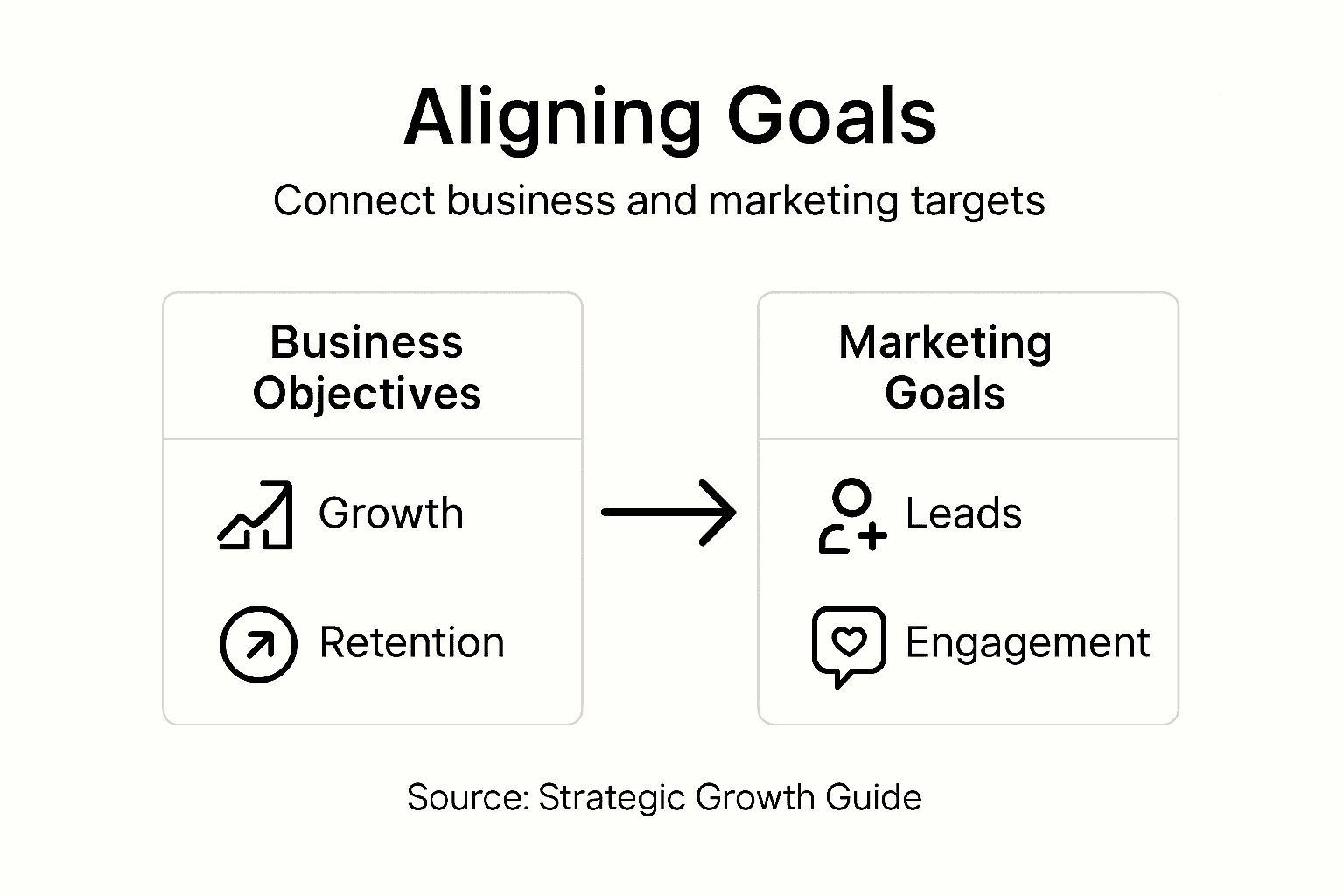
Here’s a summary of key differences between business objectives and marketing goals:
Aspect | Business Objectives | Marketing Goals |
Time Horizon | Long-term strategic view | Short- to mid-term focus |
Measurement | Organization-wide performance metrics | Campaign-specific KPIs |
Alignment | Guides overall direction | Supports business objectives |
Adaptability | Adjusted as organizational needs shift | Adapted to market and tactics |
Step 4: Map Goals to Key Performance Indicators
Mapping marketing goals to key performance indicators (KPIs) transforms abstract objectives into actionable, measurable strategies that drive meaningful business growth. This critical step creates a clear roadmap for tracking and achieving your strategic marketing targets.
KPIs support strategic decision-making by providing quantifiable metrics that directly reflect your marketing goals. Develop a comprehensive mapping strategy that connects each goal with specific, relevant performance indicators:
Website Conversion Rate Goal → Conversion Rate KPI
Lead Generation Goal → Lead Quality and Quantity KPIs
Customer Acquisition Cost Reduction → Customer Acquisition Cost Metric
Social Media Engagement Goal → Engagement Rate Indicators
Market Share Expansion → Market Penetration Metrics
Precise KPI selection requires understanding the intricate relationship between strategic objectives and performance metrics. Each indicator should provide clear, actionable insights that enable real-time strategy adjustments and performance tracking.
Key Performance Indicators are not just numbers, but strategic navigation tools that illuminate your path to marketing excellence.
Pro Tip: Conduct quarterly KPI reviews to ensure your performance indicators remain aligned with evolving business objectives and market dynamics.
Step 5: Validate Alignment with Stakeholders
Validating marketing goals and strategies with key stakeholders transforms theoretical plans into collaborative, actionable initiatives. This critical step ensures buy-in, alignment, and shared understanding across different organizational departments and leadership levels.
Stakeholder engagement requires effective communication to create a unified vision. Develop a comprehensive validation approach that involves multiple stakeholder groups:
Executive leadership review
Department heads consultation
Cross-functional team workshops
Individual strategic alignment meetings
Feedback collection and iterative refinement
Strategic communication methods are crucial when navigating digital transformation initiatives. The goal is to create a shared understanding that transcends departmental boundaries, ensuring your marketing strategy resonates with everyone’s perspectives and organizational objectives.
Successful stakeholder alignment is not about agreement, but about creating a shared understanding of strategic direction and mutual commitment.
Pro Tip: Schedule structured quarterly alignment sessions that provide transparent updates and invite collaborative input from all key stakeholders.
Step 6: Monitor Progress and Adjust Strategies
Continuous monitoring and strategic adjustment are the lifelines of successful marketing initiatives. This critical step transforms your marketing approach from a static plan to a dynamic, responsive system that adapts to changing market conditions and organizational needs.
Progress monitoring enables timely strategic adjustments by providing real-time insights into your marketing performance. Develop a comprehensive monitoring framework that includes:
Weekly performance metric reviews
Monthly comprehensive strategy assessments
Real-time dashboard tracking
Comparative analysis against initial benchmarks
Rapid response intervention protocols
Data-driven strategy refinement is crucial when implementing continuous improvement processes. Your monitoring approach should balance quantitative metrics with qualitative insights, ensuring a holistic view of marketing performance that goes beyond surface-level numbers.
Effective strategy monitoring is not about rigid adherence, but about maintaining strategic flexibility and responsive adaptation.
Pro Tip: Create automated reporting systems that flag significant performance deviations, enabling immediate strategic recalibration.
Align Your Marketing Goals with Proven Strategic Growth Solutions
Many businesses struggle to connect their marketing goals directly with measurable business outcomes. This article highlights key challenges such as setting SMART goals, mapping them accurately to KPIs, and maintaining flexibility to adjust strategies as market conditions evolve. If you find yourself facing difficulties in transforming abstract marketing aspirations into actionable strategies that truly drive growth, you are not alone.
At Unnamed Marketing Company, we specialize in bridging this gap by delivering tailored growth strategies and execution frameworks. Our expertise lies in aligning your business objectives with clear marketing goals and KPIs to ensure each initiative moves you closer to your vision. From clarifying your strategic marketing alignment and performance assessment to setting measurable goals and continuously optimizing results, our Digital Products | Unnamed Marketing Company offer innovative solutions that help you grow with intention.

Take the next step in transforming your marketing intentions into real-world success. Explore how our strategic consultancy services can help you build a strong, focused brand and a high-impact marketing plan. Visit Unnamed Marketing Company now to start aligning your marketing goals for lasting business growth.
Frequently Asked Questions
How can I define clear marketing goals that align with my business objectives?
To define clear marketing goals, start by setting SMART criteria: Specific, Measurable, Achievable, Relevant, and Time-bound. For instance, aim to increase your website conversion rates by 15% within six months.
What are the key performance indicators I should use to track my marketing goals?
Select key performance indicators (KPIs) that directly relate to your marketing goals, such as website conversion rates and customer acquisition costs. Establish a system to review these KPIs monthly to ensure you are on track and making necessary adjustments.
How often should I assess my current marketing performance?
You should assess your current marketing performance quarterly. This allows for timely identification of strengths and weaknesses, enabling you to pivot strategies or optimize campaigns based on real data insights.
What steps should I take to engage stakeholders in aligning marketing goals?
Engage stakeholders by scheduling regular alignment sessions that encourage input from various departments. Aim for at least one session per quarter to ensure all teams are informed and aligned with your marketing strategies.
What should I do if my marketing goals are not meeting performance expectations?
If your marketing goals are not being met, analyze your current strategies and performance metrics to identify gaps. Adjust your tactics and set new, realistic targets as needed, ensuring those goals are still relevant and achievable based on current market conditions.
How can I maintain flexibility in my marketing strategy to adapt to changing market conditions?
To maintain flexibility, implement a monitoring framework that includes regular performance reviews and real-time data analytics. Schedule monthly assessments to adjust your marketing approach based on emerging trends and performance shifts.
Recommended

Comments