


_edited.png)
Role of Brand Design: Driving Cross-Border Growth
- Feb 22
- 13 min read

Most Canadian marketing directors have faced moments where brand design feels like a checklist of logos and colors, yet this legacy thinking stunts cross-border growth. Brand design is a strategic business function that directly influences how American customers perceive your company and whether your expansion flourishes or fails. Misconceptions about branding’s role persist, making it vital to rethink your approach if you want improved brand recognition and lasting impact in the U.S. market.
Table of Contents
Key Takeaways
Point | Details |
Brand Design is Strategic | Treat brand design as a core business function, not just a creative task. It should align with your company’s purpose and market strategy. |
Adaptation for U.S. Market is Essential | Research and localize your brand messaging for the U.S. audience to resonate with cultural differences and customer expectations. |
Integration of Elements is Critical | Ensure your brand’s visual, semantic, and content elements are cohesive to avoid customer confusion and build trust. |
Continuous Evaluation is Necessary | Regularly audit your brand positioning and messaging, especially before entering new markets to maintain relevance and effectiveness. |
Brand design fundamentals and misconceptions
Most Canadian marketing directors grow up hearing that brand design is about logos, color palettes, and pretty marketing materials. That’s the misconception holding you back.
Brand design is a strategic business function, not a creative afterthought. It shapes how customers perceive your company, influences purchasing decisions, and determines whether your U.S. expansion succeeds or stumbles. When you fail to treat it strategically, you’re essentially leaving growth on the table.
The real problem: branding’s strategic relevance is often underappreciated. Most organizations still see branding as marketing’s job, not a core business strategy tied to your overall direction and purpose.
What Brand Design Actually Includes
Think of brand design as the complete architecture of how your company shows up in the world. It goes far beyond visuals:
Brand identity: Your visual system (logo, colors, typography) plus your voice and messaging
Brand purpose: Why your company exists beyond making money
Brand positioning: How you differentiate from competitors in the U.S. market
Brand experience: Every touchpoint a customer encounters across both countries
Brand guidelines: The systems that keep everything consistent as you scale
Each element works together. Skip one, and the others weaken.
Here is a comparison of the strategic and creative roles of brand design:
Aspect | Strategic Role | Creative Role |
Business Impact | Drives market positioning and growth | Enhances visual appeal |
Decision Influence | Guides customer choices and perceptions | Attracts initial customer attention |
Expansion Success | Enables successful U.S. entry | Supports marketing campaigns |
Longevity | Requires continual adaptation | Often seen as one-time work |
Common Misconceptions Killing Your Growth
Misconception 1: A new logo solves brand problems.
A logo refresh won’t fix a weak positioning statement or unclear brand purpose. You’re treating the symptom, not the disease. Many Canadian firms rebrand visually while their actual market identity stays muddled. In the U.S., where competition is fiercer, this strategy fails immediately.
Misconception 2: Brand design is one-time work.
Your brand isn’t static. As you enter new markets, acquire customers, and face competitive pressure, your brand must evolve. U.S. expansion demands continuous refinement, not a “set it and forget it” approach.
Misconception 3: Design is separate from strategy.
This is the biggest killer. Your brand design should visually communicate your strategy. If your strategy says “premium quality” but your design looks discount, you’ve created confusion. Strategic alignment means every design decision reflects your positioning.
Misconception 4: You can ignore cultural differences between Canada and the U.S.
What resonates in Toronto doesn’t automatically work in Texas. Brand design must account for regional preferences, messaging expectations, and cultural nuances. American customers evaluate brands differently than Canadian ones.
Brand design is a management function tied to your company’s purpose and identity, not just a creative exercise. This distinction determines whether your cross-border expansion builds momentum or stalls.
The Real Foundation
Strong brand design rests on clarity. You need to know:
Who you are: Your authentic brand identity and core values
Why you exist: Your brand purpose beyond revenue
Who you serve: Your target customer in the U.S. market
Why customers choose you: Your competitive differentiation
How you show up: Consistent visual, verbal, and experiential identity
Without these foundations, even beautiful design becomes expensive decoration.
Pro tip: Before refreshing any visual identity, audit your current brand positioning and purpose—if these aren’t clear, a design project will waste budget and confuse your U.S. audience.
Core elements of effective brand design
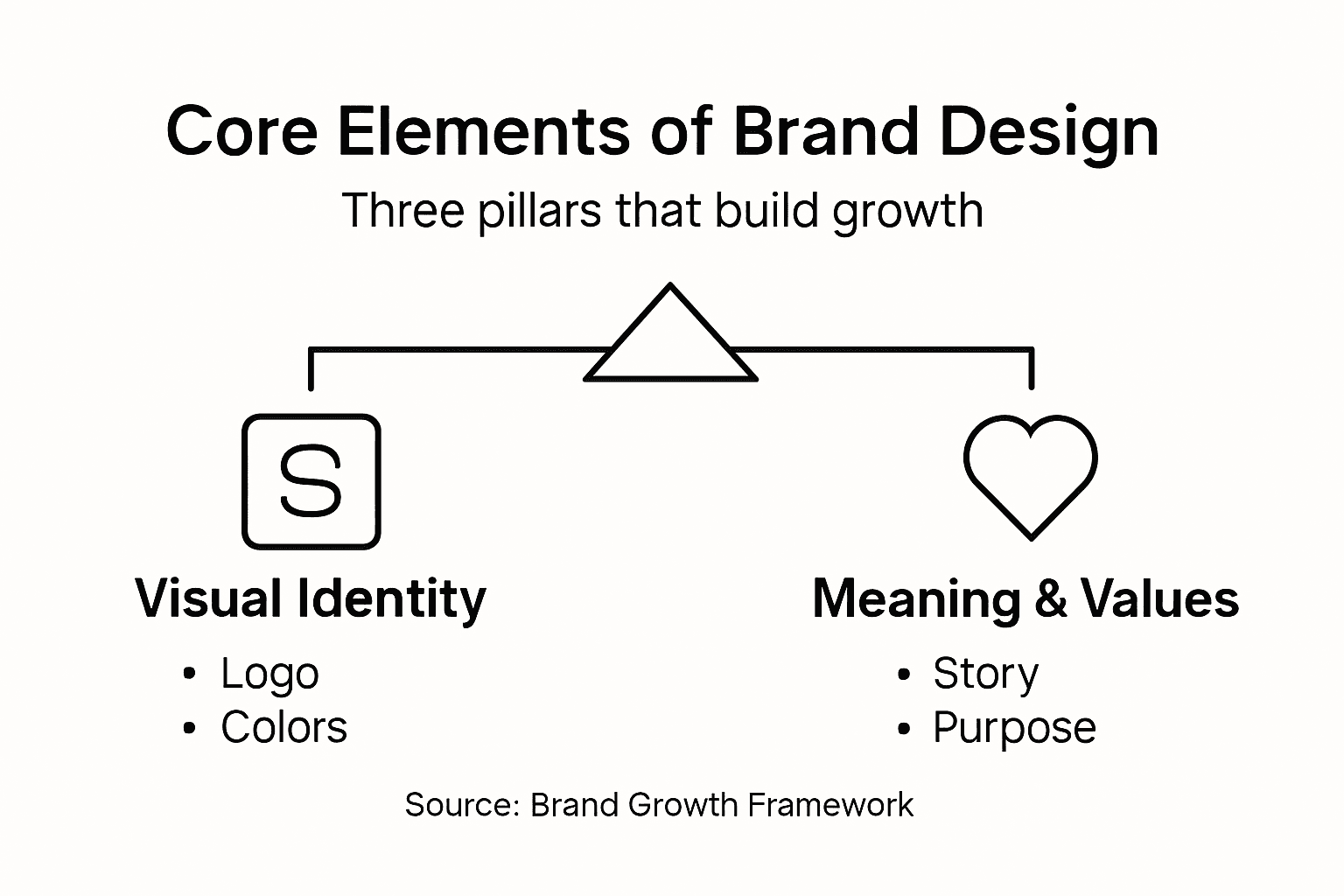
Effective brand design isn’t random. It’s built on three interconnected pillars that work together to shape how American customers perceive and engage with your Canadian company.
When these elements align, they create cognitive and emotional responses that drive customer loyalty. When they clash, you lose credibility instantly—especially in a competitive U.S. market where customers have options.
Let’s break down what actually matters.
Three Core Elements That Drive Results
Brand design operates across three layers:
Structure: The visual foundation (logos, color schemes, fonts)
Semantics: The meaning layer (product appearance, slogans, stories)
Content: The values layer (brand values, personalized messaging)
Each layer serves a purpose. Structure catches attention. Semantics creates understanding. Content builds connection.
Ignore any layer, and your brand feels incomplete.
Structure: What People See First
Your visual identity is your handshake with American customers. This includes your logo, color palette, typography system, and overall design language.

Structural elements work because they’re instantly recognizable. When a customer sees your colors or logo, they should immediately know it’s you—not your competitor.
Consistency matters enormously. A logo that changes across platforms, inconsistent colors, or mismatched fonts signal that you’re unprofessional or disorganized. In the U.S., where brand trust is competitive currency, this kills momentum.
Semantics: The Meaning Behind Visuals
Semantics is where your brand tells a story. It includes your slogans, the way you present products, and the narratives you use to connect emotionally.
Here’s what most Canadian firms miss: logos, slogans, and visual identity create emotional connections that make brands memorable. A great slogan doesn’t just describe what you do—it explains why customers should care.
When your U.S. messaging says “innovation” but your visuals look traditional, you’ve created semantic confusion. American customers notice the disconnect immediately.
Content: The Values That Sustain Loyalty
Content is your brand’s personality and values. It’s the personalized messaging you use with customers, the stories you tell, and the principles you actually live by.
This layer determines whether customers feel understood. When you personalize your message to U.S. market segments—accounting for regional differences, industry challenges, and customer pain points—you move from generic to relevant.
Consistency, distinctiveness, and emotional connection across all three elements differentiate your brand and create the memorable identity that resonates with customers in both markets.
How These Elements Work Together
Imagine launching in the U.S. with:
A polished logo and color system (structure) ✓
A compelling product story and slogan (semantics) ✓
Personalized messaging for different customer segments (content) ✓
Now imagine missing one piece. Your messaging is great, but your visuals don’t reflect your positioning. Your logo is beautiful, but your values contradict your slogans. The brand feels fragmented.
Integration across all three elements is what separates thriving cross-border brands from ones that plateau.
Pro tip: Audit all three elements simultaneously when planning your U.S. expansion—don’t design your logo, then later discover your messaging contradicts your visual identity.
Brand design strategies for U.S. expansion
Expanding into the U.S. market requires more than copying your Canadian brand playbook. American customers have different expectations, regional preferences, and competitive alternatives. Your brand design strategy must account for these realities.
Success starts with understanding that adapting visual identity and messaging to fit cultural and market expectations is non-negotiable. Your logo, colors, and messaging that work in Toronto might confuse or alienate U.S. audiences.
Here’s how to get it right.
Start with Deep Market Research
Before touching your brand design, understand your U.S. market. This isn’t guesswork—it’s strategic foundation.
Conduct research on:
Regional preferences: What resonates in California versus Texas versus New York?
Competitor positioning: How do established U.S. players position themselves?
Customer expectations: What do American customers in your industry expect from brands?
Cultural nuances: Which messaging triggers positive or negative reactions?
Canadian firms often skip this step. They assume market knowledge transfers. It doesn’t.
Localize Without Losing Identity
Localization doesn’t mean abandoning your brand. It means expressing your core identity in ways that resonate locally.
Your global brand elements—values, core messaging, visual DNA—stay consistent. But how you communicate them shifts. A Canadian financial services firm might emphasize stability and trust. In the U.S., that same firm could lead with innovation and accessibility to different customer segments.
The brand voice adapts. The brand foundation doesn’t.
Build Clear Competitive Differentiation
The U.S. market has bigger, louder competitors with deeper budgets. Your brand design must make you visually and verbally distinct.
Differentiation comes from:
Unique visual assets that competitors don’t own
Specific positioning language that only you can claim authentically
Consistent application across all customer touchpoints
When your U.S. customers can’t distinguish you from five other Canadian entrants, price becomes the only differentiator. That’s a race you’ll lose.
Align Brand and Business Strategy
Many Canadian companies separate these. They shouldn’t.
Your brand design should visually and verbally communicate your business strategy. If your business strategy targets mid-market companies seeking rapid implementation, your brand shouldn’t look premium and enterprise-focused.
This alignment signals authenticity and builds trust with American customers who are skeptical of generic branding.
Market analysis, competitive differentiation, and localized communication combined with consistent global brand elements create the foundation for successful U.S. expansion.
Test Before Full Launch
Don’t rebrand nationally without validation. Test your design strategy with U.S. focus groups or beta customers first.
Show them your new visual identity, messaging, and positioning. Ask direct questions:
What does this brand stand for?
How is it different from competitors?
Would you trust this company?
Does this feel authentic or forced?
Their feedback prevents expensive mistakes.
Pro tip: Test your brand design with geographically diverse U.S. audiences—what works in urban markets may fail in rural areas, and vice versa.
Aligning design with business goals and culture
Here’s what separates thriving Canadian brands in the U.S. from ones that flounder: they embed their business strategy directly into their brand design.
Your brand isn’t separate from how your company operates. It’s the visible expression of it. When design, business goals, and company culture misalign, customers sense the disconnect immediately.
Americans are particularly good at spotting authenticity gaps. They’ll notice if your brand promises innovation but your internal processes are outdated. They’ll see if you claim customer-centricity while your website experience is clunky.
Alignment fixes this.
Why Alignment Matters for Cross-Border Growth
When you expand into the U.S., internal misalignment becomes a growth barrier. Your team in Canada operates one way. Your U.S. partners expect another. Your brand messaging promises a third.
The result: inconsistent customer experiences that erode trust and loyalty.
Aligning organizational culture with strategic goals enhances brand design effectiveness by embedding brand purpose directly into daily operations. Your employees become brand ambassadors. Your systems support brand promises. Your customer experience reflects your positioning.
Without this alignment, your brand design becomes decoration on a broken foundation.
Start with Your Business Goals
What are you actually trying to accomplish in the U.S. market? Be specific.
Your business goals might include:
Capture mid-market customers in financial services
Position as the affordable-premium alternative
Build brand awareness in three major metro areas
Achieve 15% market share in three years
Your brand design should visually and verbally communicate these exact goals. If you’re targeting mid-market customers but your design looks ultra-premium and exclusive, you’ve created misalignment from day one.
Assess Your Actual Culture
Most Canadian companies have an aspirational culture and an actual culture. Know which is which.
If your actual culture is hierarchical and slow-moving, don’t design a brand that promises agility and radical transparency. Customers will experience the gap within weeks.
Instead, design a brand that authentically reflects who you are now, then work internally to shift the culture if needed. Authenticity matters more than aspiration in the U.S. market.
Bridge the Gap
Identify where design, goals, and culture diverge. Then fix it.
Common gaps:
Brand promises innovation → Team operates with traditional processes
Design emphasizes sustainability → Supply chain practices contradict it
Messaging highlights transparency → Internal communication is siloed
Positioning targets values-driven customers → Company culture doesn’t reflect those values
Purpose-driven branding that aligns business goals with organizational culture achieves stronger brand image, customer trust, and loyalty by connecting objectives meaningfully.
Make It Operational
Alignment isn’t a one-time project. Build it into how you operate.
Create systems that:
Measure whether your customer experience matches your brand promise
Train employees on brand values and expectations
Hold leaders accountable for cultural alignment with brand positioning
Regularly audit messaging against actual company practices
When your U.S. sales team, customer success team, and marketing team all understand and live the brand, consistency follows.
Pro tip: Before launching your U.S. brand, have your Canadian leadership team spend a full day auditing the gaps between your brand promises and your actual operations—this prevents expensive brand credibility damage.
Risks and common mistakes in cross-border branding
Expanding your Canadian brand into the U.S. comes with real dangers. Many mid-sized firms stumble here because they underestimate how different American markets actually are.
The cost of getting it wrong isn’t a rebranding project. It’s lost revenue, damaged reputation, and wasted time rebuilding trust.
Let’s look at what derails cross-border brands.
The Big Picture Risks
Cross-border branding faces fundamental risks that generic branding doesn’t. Understanding these upfront prevents expensive mistakes.
Key risks include:
Insufficient brand awareness: Americans don’t know you exist yet. Building recognition costs time and money.
Cultural misalignment: What resonates in Canada falls flat in Texas or New York.
Lack of competitiveness: U.S. markets have entrenched competitors with deeper resources.
Logistical challenges: Managing brand consistency across two countries with different teams and systems is hard.
Trust deficits: You’re an unknown foreign brand entering a skeptical market.
Each risk compounds the others. Ignoring one amplifies the rest.
This table summarizes the major risks Canadian brands face when expanding to the U.S.:
Risk | Description | Consequence |
Insufficient Awareness | U.S. customers unfamiliar with your brand | Slower adoption, lost sales |
Cultural Misalignment | Brand doesn’t match regional expectations | Reduced trust and relevance |
Inconsistent Identity | Visuals and messaging lack cohesion | Customer confusion, weak loyalty |
Trust Deficit | Lack of credibility in new market | Increased skepticism, lost deals |
Mistake 1: Poor Localization
This is the killer. Many Canadian brands attempt minimal localization, assuming American customers are basically the same.
They’re not. Poor adaptation to local markets and ignoring cultural nuances directly hinder brand growth internationally. A financial services brand that works in Toronto won’t automatically work in Atlanta without significant adaptation.
Localization means more than translating English to English. It means understanding regional preferences, competitive positioning, and customer expectations in specific U.S. markets.
Mistake 2: Direct Translation Disasters
This sounds obvious, but it happens constantly. Companies take their Canadian messaging and assume it translates directly to American audiences.
Over-reliance on direct translation and neglecting local consumer values damages brand reputation and effectiveness. A slogan that works in one culture can confuse or offend in another. Messaging priorities shift. Tone preferences change.
Your U.S. messaging needs to be written for American customers, not translated from Canadian copy.
Mistake 3: Ignoring Cultural Differences
Canadian and American business cultures differ more than most Canadian firms realize. Americans value different things, make decisions differently, and evaluate brands differently.
Failing to embrace these differences means:
Your brand positioning misses what U.S. customers actually care about
Your sales messaging doesn’t align with American buying psychology
Your customer experience doesn’t match expectations
Trust erodes because the experience feels off
Mistake 4: Inconsistent Brand Identity Across Markets
Managing consistent brand identity while adapting for local markets is genuinely hard. Many firms either over-adapt (losing brand coherence) or under-adapt (losing relevance).
Your logo, core values, and brand foundation stay consistent. Your application, messaging, and positioning shift.
Get this balance wrong, and customers in both markets become confused about who you actually are.
Mistake 5: Failing to Build Local Trust
Trust is currency in American markets. You start with zero.
Building it requires:
Transparent communication about who you are
Consistent delivery on brand promises
Local credibility markers (partnerships, testimonials, proven results)
Patient relationship building
Many Canadian firms rush this. They expect U.S. customers to trust them as quickly as Canadian customers do. It doesn’t work that way.
Effective solutions involve detailed market research, localization, and robust global brand management to navigate cultural differences and build sustainable brand equity in new markets.
Pro tip: Before launching your U.S. brand, conduct at least one focus group with American customers in your target market—hearing their honest reactions to your positioning and messaging prevents costly mistakes after launch.
Unlock Your Cross-Border Brand Potential with Strategic Design
Expanding your Canadian brand into the American market means overcoming challenges like cultural misalignment, inconsistent brand identity, and lack of local trust. If you’re struggling to align your brand design with your business goals and connect authentically with U.S. customers, it is time to act strategically. At Unnamed Marketing Company, we understand the critical role that brand design as a strategic business function plays in driving sustainable growth and competitive differentiation.

Explore our Digital Products designed to bridge the gap between creative visuals and business strategy. Our proven frameworks help you embed your authentic brand purpose into every touchpoint, tailor your messaging for American audiences, and create a cohesive brand experience that builds trust and loyalty. Visit Unnamed Marketing Company today to start crafting a brand design that powers your U.S. expansion and delivers real-world results with intention.
Frequently Asked Questions
What is the primary function of brand design in a business strategy?
Brand design serves as a strategic function that shapes customer perception, influences purchasing decisions, and aligns with overall business objectives, rather than being just a creative exercise.
How should brand design evolve when entering new markets?
Brand design should continuously adapt to reflect the specific cultural nuances, preferences, and expectations of the new market, ensuring consistency while still resonating locally.
What are the key elements of effective brand design?
Effective brand design consists of three core elements: structure (visual identity), semantics (meaning and storytelling), and content (brand values and messaging). Each element works together to create a cohesive brand experience.
How can companies ensure alignment between their brand design and business goals?
To ensure alignment, companies should clearly define their business objectives and ensure that their brand design visually and verbally communicates these goals, creating a consistent messaging strategy that resonates with target audiences.
Recommended

Comments