


_edited.png)
Brand Architecture: Unlocking Clarity in Expansion
- Feb 18
- 8 min read

Expanding into the American market often reveals gaps in how Canadian service firms structure their brands. Without a clear framework, messaging becomes inconsistent and customers struggle to differentiate offerings. Establishing brand architecture gives your firm a strategic blueprint that clarifies relationships and maximizes impact across products and services. This article uncovers common myths, outlines key models, and highlights practical strategies for building a brand portfolio that supports sustainable growth across North America.
Table of Contents
Key Takeaways
Point | Details |
Understanding Brand Architecture | It is an organizational framework that defines the relationships between a company’s main brand and its sub-brands, impacting brand positioning and strategy. |
Models of Brand Architecture | The primary models include Branded House, House of Brands, and Hybrid, each serving different strategic needs for brand organization. |
Importance of Flexibility | Brand architecture should be adaptable to changing market dynamics, ensuring that it accurately supports the business strategy and responds to customer preferences. |
Risk Management | Companies must be vigilant against pitfalls like brand dilution and legal challenges, employing regular audits and strategic reviews to protect brand equity. |
Defining Brand Architecture and Common Myths
Brand architecture represents the strategic framework that defines complex relationships between a company’s core brand and its various sub-brands. At its core, brand architecture serves as an organizational blueprint that clarifies brand positioning, messaging, and strategic relationships across an entire corporate ecosystem.
Contrary to popular misconceptions, brand architecture extends far beyond visual design elements like logos or names. Strategic brand relationships actually encompass a holistic communication system that transmits brand philosophy through multiple interconnected channels. This framework helps companies achieve several critical objectives:
Reduce market confusion about brand offerings
Align messaging across different product lines
Create clear hierarchical relationships between brands
Facilitate strategic decision-making about brand investments
Maximize brand equity and customer recognition
Many business leaders mistakenly view brand architecture as a static organizational chart. In reality, it’s a dynamic system that evolves with market conditions, customer preferences, and organizational growth. The architecture actively shapes how customers perceive and interact with different brand entities.
Brand architecture is not just about visual design, but a comprehensive strategy for communicating brand identity and value across multiple touchpoints.
Effective brand architecture requires consistent application of core principles like localization, empathy, and strategic aesthetic alignment. Companies must thoughtfully design their brand relationships to foster trust, engagement, and long-term customer loyalty.
Pro tip: Regularly audit your brand architecture to ensure it accurately reflects your current business strategy and market positioning.
Major Models: Branded House, House of Brands, Hybrid
Companies leverage three primary brand architecture models to strategically organize their brand portfolios: the Branded House, House of Brands, and Hybrid approach. Brand architecture models represent critical strategic frameworks that help businesses communicate their brand relationships and market positioning.
In the Branded House model, a single master brand dominates the entire brand ecosystem. This approach creates a unified brand identity where all products and services are visibly connected to the primary corporate brand. Examples of this model include companies like Google, where products like Gmail, Google Drive, and Google Maps all prominently feature the parent brand name:
Strong visual and messaging consistency
Simplified brand recognition
Lower marketing and branding costs
Enhanced corporate brand equity
Easier customer understanding of brand relationships
The House of Brands model represents a completely different strategy. Here, the parent company maintains multiple independent brands with distinct identities, personalities, and market positions. Procter & Gamble exemplifies this approach, owning diverse brands like Tide, Gillette, and Pampers that operate with minimal visible connection to the parent corporation.
The Hybrid model offers strategic flexibility, allowing companies to balance unified branding with independent sub-brand identities.
The Hybrid model emerges as a sophisticated approach that combines elements from both Branded House and House of Brands strategies. This flexible model enables companies to maintain a cohesive corporate identity while allowing individual brands significant autonomy in market positioning and customer engagement.
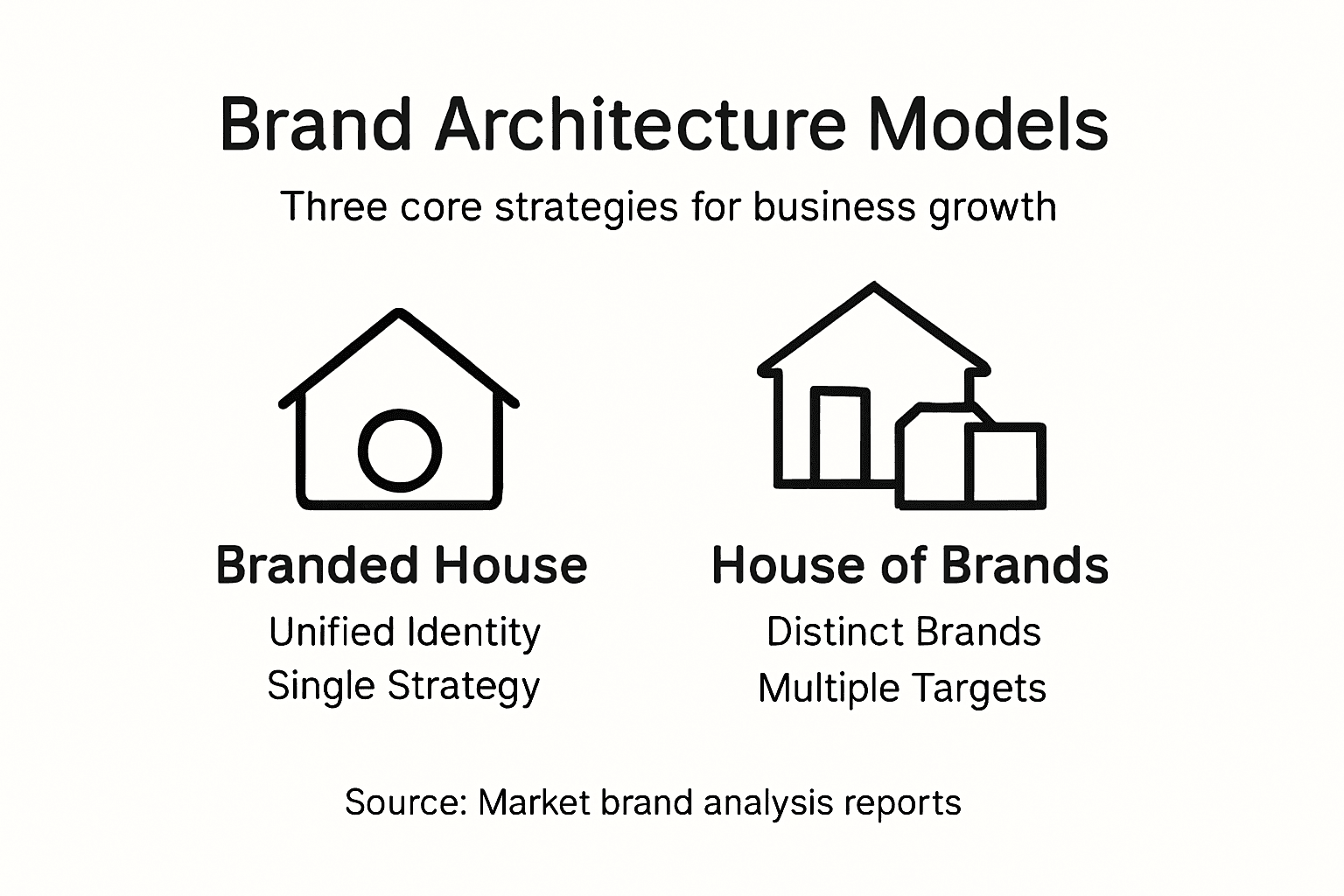
Here’s a side-by-side look at the three main brand architecture models for quick comparison:
Model | Core Focus | Best For | Notable Example |
Branded House | Unified brand identity | Aligned products/services | |
House of Brands | Distinct sub-brand autonomy | Diverse portfolios | Procter & Gamble |
Hybrid | Balance of unity and autonomy | Complex brand needs | Marriott |
Pro tip: Conduct a comprehensive brand portfolio analysis every two years to determine which architecture model best supports your current business strategy and market dynamics.
Key Features: Brand Relationships and Structure
Brand architecture represents a sophisticated strategic framework that defines critical organizational relationships and communication structures within a company’s brand portfolio. Multidimensional brand structures extend far beyond simple visual connections, encompassing complex interactions between brands, stakeholders, and market perceptions.
The key features of effective brand architecture include several critical dimensions:
Hierarchical organization of brand relationships
Clear definition of brand roles and boundaries
Strategic alignment between corporate and consumer perceptions
Optimization of brand awareness and equity transfer
Flexibility to adapt to changing market dynamics
At its core, brand architecture serves as an organizational blueprint that clarifies the intricate connections between different brands within a company’s portfolio. This structure helps businesses communicate subtle differences and similarities among their products and services, ultimately guiding consumer understanding and purchase decisions.
Brand architecture is not just an internal organizational tool, but a strategic communication mechanism that shapes market perception and consumer engagement.
Successful brand architecture requires a nuanced approach that balances consistency with flexibility. Companies must carefully consider brand breadth and depth, ensuring that each brand within the portfolio can maintain its unique identity while contributing to the overall corporate brand strategy.

Pro tip: Develop a comprehensive brand mapping exercise annually to assess and refine your brand architecture strategy.
How Brand Architecture Enables Growth and Expansion
Brand architecture serves as a critical strategic mechanism that empowers companies to navigate complex market expansions with precision and clarity. Strategic brand growth frameworks enable businesses to protect core brand equity while simultaneously exploring new market opportunities and product categories.
The key growth enablers of robust brand architecture include:
Protecting premium brand positioning
Supporting targeted market segmentation
Facilitating efficient resource allocation
Enabling agile product launches
Maintaining consistent brand messaging
Reducing marketing and communication complexities
By creating a clear organizational framework, brand architecture allows companies to strategically expand without diluting their core brand identity. This approach provides a structured pathway for introducing new products, entering different market segments, or exploring geographic territories while maintaining a coherent brand narrative.
Brand architecture transforms expansion from a risky venture into a calculated, strategic opportunity for sustainable growth.
Successful brand expansion requires more than just visual consistency. It demands a deep understanding of how different brands within a portfolio can communicate, collaborate, and create value. Companies that leverage sophisticated brand architecture can develop emotional connections with customers, streamline marketing efforts, and create scalable growth strategies that adapt to changing market dynamics.
Pro tip: Conduct a comprehensive brand portfolio review every 18 months to identify potential expansion opportunities and realign your brand architecture strategy.
Pitfalls, Legal Risks, and Market Challenges
Brand architecture strategies are fraught with complex challenges that can significantly impact a company’s market positioning and financial performance. Brand reputation risks emerge from strategic missteps that can potentially undermine years of carefully built brand equity and customer trust.
The primary pitfalls companies must navigate include:
Brand dilution and identity erosion
Potential market cannibalization
Unintended brand stretch risks
Regulatory compliance challenges
Complex legal ownership restrictions
Financial volatility from brand mismanagement
Legal considerations represent a particularly nuanced dimension of brand architecture. Companies must meticulously manage contract restrictions, intellectual property rights, and naming conventions to avoid potential litigation and protect their brand investments. This requires a proactive approach that anticipates potential legal complications before they manifest.
Strategic brand management demands continuous vigilance against risks that could compromise organizational reputation and market positioning.
Market challenges in brand architecture often stem from misalignment between brand strategy and consumer perception. Companies must develop sophisticated mechanisms to monitor brand performance, track market reactions, and quickly adapt their architectural approach to changing competitive landscapes. Failure to do so can result in decreased market relevance and diminished brand value.
Below is a summary of key brand architecture pitfalls alongside recommended risk mitigation strategies:
Common Pitfall | Business Impact | Risk Mitigation Strategy |
Brand dilution | Loss of market distinction | Regular brand audits |
Market cannibalization | Sales shifted between brands | Clear positioning guidelines |
Legal missteps | Costly litigation or rebranding | Ongoing legal counsel review |
Brand stretch | Customer confusion | Strategic portfolio reviews |
Pro tip: Engage specialized legal counsel with brand architecture expertise to conduct comprehensive risk assessments at least annually.
Choosing the Right Model for Your Service Firm
Selecting the appropriate brand architecture model represents a critical strategic decision for service firms seeking sustainable growth and market differentiation. Brand management frameworks provide nuanced approaches that align organizational identity with market positioning and strategic objectives.
The key considerations for selecting the right brand architecture model include:
Cohesiveness of service offerings
Target market segmentation strategy
Current and projected business growth trajectory
Complexity of service product lines
Resource allocation capabilities
Competitive market landscape
Long-term brand expansion goals
Professional service firms must carefully evaluate their unique organizational context when determining the most appropriate architectural approach. The Branded House model works exceptionally well for firms with closely related services and a strong, unified brand identity. Conversely, the House of Brands strategy becomes advantageous when managing diverse service lines that require distinct market positioning.
Effective brand architecture transforms organizational complexity into strategic advantage, creating clear pathways for market communication and growth.
The Hybrid model emerges as a sophisticated solution for service firms navigating complex market dynamics. This approach allows organizations to maintain core brand consistency while providing flexibility for individual service lines to develop unique market identities. Strategic flexibility becomes the hallmark of successful brand architecture in rapidly evolving professional service environments.
Pro tip: Conduct a comprehensive brand audit every 24 months to reassess and recalibrate your brand architecture strategy.
Unlock Strategic Growth with Expert Brand Architecture Guidance
Navigating the complexities of brand architecture is essential for achieving clarity and sustainable growth in today’s competitive market. If you are facing challenges such as aligning your brand portfolio, reducing market confusion, or balancing unified and autonomous brand identities, you are not alone. Understanding whether a Branded House, House of Brands, or Hybrid model fits your service firm can be daunting without expert support. Effective brand architecture drives trust, engagement, and long-term loyalty while minimizing risks like brand dilution and legal pitfalls.
At Unnamed Marketing Company, we specialize in strategic growth and brand consultancy that bridges the gap between theory and execution. Our proven frameworks focus on aligning your brand design and marketing planning to your unique business goals. Explore our Digital Products designed to guide firms like yours through complex brand structures and expansion strategies.

Gain clarity in your brand’s growth journey today. Visit Unnamed Marketing Company for expert insights and actionable strategies that transform your brand architecture into a powerful driver of market success. Let us help you build a cohesive brand ecosystem that grows with intention.
Frequently Asked Questions
What is brand architecture?
Brand architecture is a strategic framework that defines the relationships between a company’s core brand and its various sub-brands, serving as an organizational blueprint for messaging and positioning.
Why is brand architecture important for business growth?
Brand architecture enables businesses to reduce market confusion, align messaging, manage brand relationships strategically, and maximize brand equity, all of which are vital for sustainable growth and expansion.
What are the different models of brand architecture?
The three primary models of brand architecture are the Branded House, House of Brands, and Hybrid model. Each offers a different approach to organizing brand portfolios based on products and market strategies.
How often should a company audit its brand architecture?
Companies should regularly audit their brand architecture—ideally once every two years—to ensure it reflects the current business strategy, market positioning, and evolving customer preferences.
Recommended

Comments