


_edited.png)
Step by Step Brand Positioning for U.S. Expansion Success

Breaking into the American market can feel like an uphill battle when every competitor claims to be unique. For Toronto-based professional service firms, success starts by defining exactly what sets your brand apart. A clear understanding of your unique market opportunity shapes every decision and drives long-term growth. You will discover how targeted research, structured frameworks, and honest feedback help craft a compelling foundation for expansion into the United States.
Table of Contents
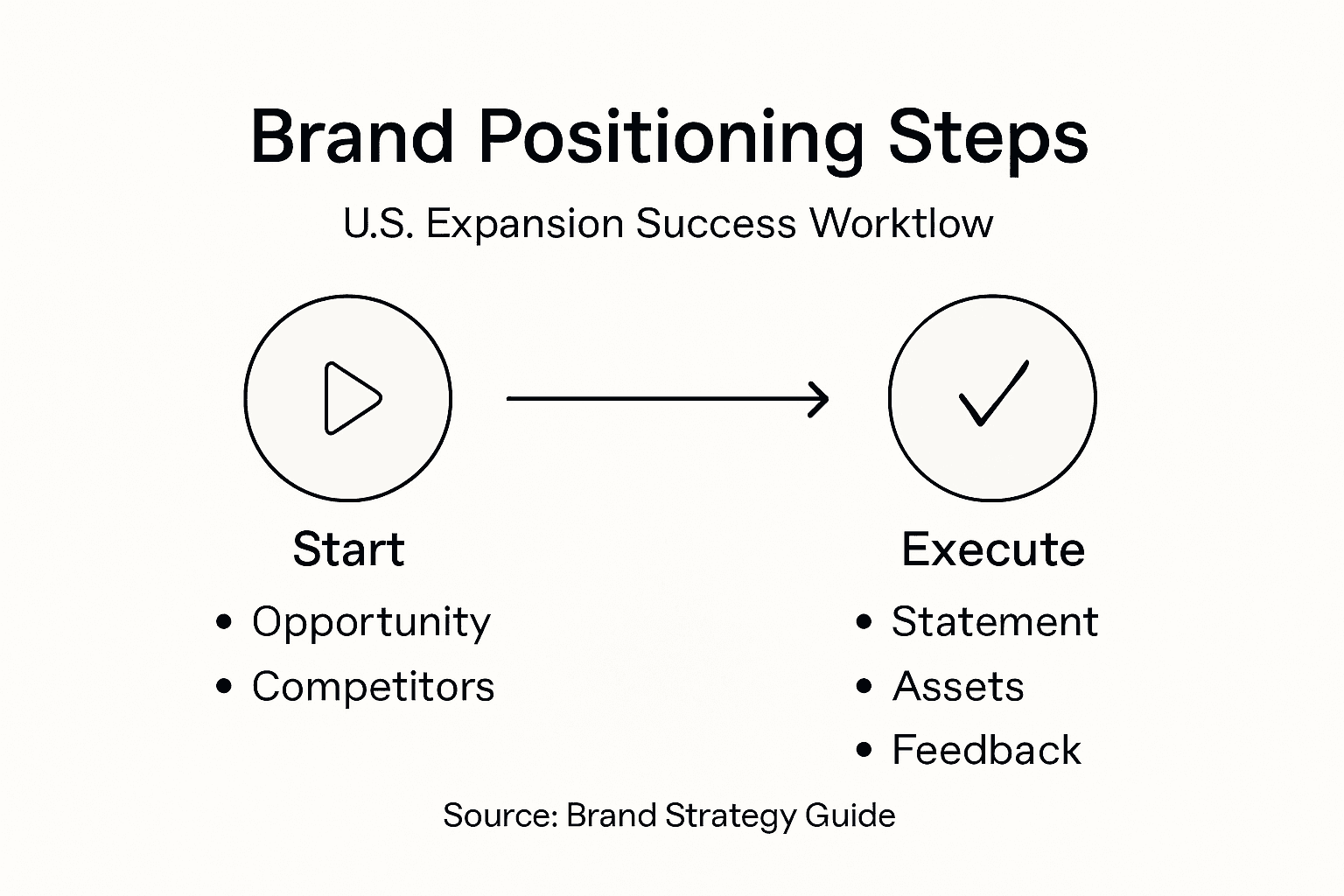
Quick Summary
Key Point | Explanation |
1. Identify Your Unique Opportunity | Understand what differentiates your brand and how it solves customer issues uniquely. |
2. Conduct Thorough Competitor Research | Analyze competitors comprehensively to identify positioning advantages and market gaps you can exploit. |
3. Develop a Strong Positioning Statement | Create a concise statement that articulates your brand’s unique value and differentiates it from competitors. |
4. Align All Marketing Assets | Ensure consistency in messaging across all platforms to create a unified story that resonates with your audience. |
5. Validate Positioning with Feedback | Collect and analyze real-world customer feedback to refine your positioning strategy and enhance market fit. |
Step 1: Define your unique market opportunity
Defining your brand’s unique market opportunity is a critical foundation for successful U.S. expansion. This step involves identifying precisely what sets your business apart and how your offering solves specific customer problems in ways competitors cannot.
To pinpoint your unique market opportunity, start by conducting deep market segment research that goes beyond surface-level demographics. Strategic positioning frameworks recommend analyzing several key dimensions:
Customer pain points your solution uniquely addresses
Psychological and functional needs not currently met by competitors
Specific industry segments where your expertise creates maximum value
Distinctive capabilities that differentiate your brand
Begin by mapping your core strengths against market gaps. Consider these strategic questions:
What specific customer problems can your business solve more effectively?
Where do current market solutions fall short?
What unique combination of skills, technology, or approach do you bring?
Your unique market opportunity emerges at the intersection of your strengths and unmet customer needs.
Competitive analysis is crucial in this process. Study your potential U.S. competitors thoroughly, identifying not just what they do, but how and where they might be underserving specific customer segments.

Pro tip: Validate your unique market opportunity through targeted customer interviews and pilot programs before fully committing to your U.S. market strategy.
Step 2: Research and analyze competitor brands
Competitor research is a strategic imperative for understanding your potential market position in the United States. This step involves systematically dissecting your competitors’ strengths, weaknesses, and market approaches to identify opportunities for differentiation.
Comprehensive competitor analysis requires a multifaceted approach that goes beyond surface-level observations. Your research should encompass:
Detailed review of competitors’ brand positioning
Analysis of their marketing messaging and communication strategies
Evaluation of product/service offerings and pricing models
Assessment of their customer engagement techniques
Identification of potential market gaps they are not addressing
Begin your competitive research through these structured steps:
Identify direct and indirect competitors in your industry
Collect publicly available information about their business strategies
Analyze their online presence and digital marketing approaches
Review customer reviews and feedback about their offerings
Map their strengths and potential vulnerabilities
Strategic competitor analysis reveals more than just what your rivals do - it uncovers how you can uniquely position your brand.
Utilize digital research tools and public information sources to gather comprehensive insights. This might include examining their websites, social media channels, annual reports, and industry publications.
Pro tip: Create a structured spreadsheet to systematically document and compare competitor insights, allowing for easier pattern recognition and strategic planning.
Step 3: Craft a compelling brand positioning statement
Crafting a compelling brand positioning statement is your strategic roadmap for communicating your unique value in the competitive U.S. market. This critical document distills your brand’s essence into a powerful, concise narrative that differentiates you from competitors.
Strategic brand positioning frameworks provide a structured approach to developing a statement that resonates with your target audience. Your positioning statement should clearly articulate:
Who your target customers are
The specific problem you solve
Why your solution is uniquely valuable
How you differ from competitors
The emotional and functional benefits you deliver
Develop your positioning statement through these key steps:
Define your target customer segment
Identify your core product or service offering
Articulate your primary competitive advantage
Specify the key benefits you deliver
Validate the statement against your brand’s genuine capabilities
A powerful positioning statement acts as your brand’s internal compass, guiding every marketing and communication strategy.
Focus on creating a statement that is clear, memorable, and authentic. Avoid industry jargon and complex language. Your goal is to communicate your value proposition in a way that immediately connects with potential U.S. customers.
Pro tip: Test your positioning statement with a diverse group of stakeholders to ensure it resonates across different perspectives and accurately represents your brand’s unique value.
Step 4: Align marketing assets with new positioning
Aligning your marketing assets with your new brand positioning is critical for creating a cohesive and compelling narrative in the U.S. market. This process ensures that every communication channel reinforces your unique value proposition and speaks directly to your target audience.
Strategic brand communication frameworks emphasize the importance of consistent messaging across all touchpoints. Your marketing assets should reflect your positioning statement through:
Visual branding elements
Website and digital content
Social media messaging
Sales collateral
Customer communication materials
Advertising and promotional content
Implement your alignment strategy through these systematic steps:
Conduct a comprehensive marketing asset audit
Identify gaps between current messaging and new positioning
Update visual identity elements
Revise written communication across all platforms
Train internal teams on new brand positioning
Consistency is the key to building trust and recognition in a new market.
Focus on seamless brand representation that tells a unified story. This means ensuring that your color schemes, tone of voice, imagery, and key messages all work together to communicate your brand’s unique value.
Pro tip: Create a detailed brand guidelines document that serves as a comprehensive reference for maintaining positioning consistency across all marketing channels.
Step 5: Validate your positioning with real-world feedback
Validating your brand positioning through real-world feedback is crucial for ensuring your strategic approach resonates with the U.S. market. This step transforms theoretical positioning into a living, responsive strategy that adapts to actual customer perceptions and experiences.
Brand positioning validation techniques provide essential insights into how your market perceives your unique value proposition. Your feedback collection should encompass multiple channels:
Customer interviews and surveys
Focus group discussions
Social media sentiment analysis
Website and digital engagement metrics
Sales team feedback
Initial customer interaction reports
Implement a comprehensive validation process through these strategic steps:
Design targeted feedback instruments
Collect responses from diverse customer segments
Analyze feedback for consistent patterns
Identify potential positioning refinements
Develop an iterative adjustment strategy
Authentic feedback is the compass that guides your brand’s true north in a new market.
Pay special attention to quantitative and qualitative data that reveals deeper insights about how your positioning connects with potential customers. Look beyond surface-level responses to understand the emotional and rational drivers behind customer perceptions.
Compare validation methods for brand positioning effectiveness:
Method | Insight Type | Recommended Use Case |
Customer Interviews | Qualitative | Understand deep attitudes and motivators |
Surveys | Quantitative | Gather structured feedback at scale |
Focus Groups | Mixed | Test messaging with target personas |
Social Media Analysis | Behavioral/Emotional | Spot real-time sentiment trends |
Digital Metrics | Quantitative | Track engagement and conversion rates |
Pro tip: Create a structured feedback template that captures both numerical ratings and open-ended insights to provide a comprehensive view of your brand positioning’s effectiveness.
Here’s a comparison of key elements for successful U.S. market entry:
Element | Purpose | Common Pitfall |
Unique Market Opportunity | Identify brand strengths and customer needs | Overlooking unmet needs |
Competitor Analysis | Spot differentiation opportunities | Focusing on direct rivals only |
Brand Positioning Statement | Communicate concise, memorable brand value | Using vague language |
Marketing Asset Alignment | Ensure unified messaging across all channels | Inconsistent brand imagery |
Positioning Validation | Adapt strategy based on real customer feedback | Ignoring negative responses |
Unlock Your Brand’s Full Potential for U.S. Expansion
Expanding into the U.S. market means mastering your unique market opportunity, crafting a precise brand positioning statement, and aligning your marketing assets for maximum impact. If you are facing challenges like defining your brand’s distinctive value or validating your positioning through real customer feedback, you are not alone. Many businesses struggle with creating a clear, memorable narrative that resonates with American audiences and sets them apart from competitors.
At Unnamed Marketing Company, we understand these hurdles and help you move beyond theory to execution. Our strategic growth and brand consultancy services focus on clarifying your direction, building strong brand positioning, and aligning marketing assets to create consistent messaging that connects emotionally and functionally. Explore our Digital Products designed to equip you with tools for market analysis and competitor insights.

Take the next step toward market success by partnering with experts who specialize in translating your unique strengths into compelling, actionable strategies. Visit Unnamed Marketing Company to discover how we help brands plan, position, and scale with intention. Act now to start building a brand that truly resonates with the U.S. market and drives measurable growth.
Frequently Asked Questions
How do I define my unique market opportunity for U.S. expansion?
To define your unique market opportunity, start by identifying what sets your business apart and how it addresses specific customer problems. Conduct deep market segment research and pinpoint customer pain points, unmet needs, and industry segments where you excel.
What competitive analysis steps should I take for effective brand positioning?
Begin by identifying both direct and indirect competitors in your market. Analyze their strengths, weaknesses, messaging, and customer engagement techniques to uncover potential gaps that your brand can fill.
What should be included in my brand positioning statement?
Your brand positioning statement should consist of your target customer segment, the specific problem you solve, the unique value of your solution, and how you differ from competitors. Craft it clearly and memorably to ensure it aligns with your overall brand identity.
How can I align my marketing assets with new brand positioning?
Conduct a comprehensive audit of your marketing assets to identify inconsistencies between current messaging and your new positioning. Update visuals, written content, and train internal teams to ensure cohesive communication across all channels.
What are the best methods to validate my brand positioning?
Utilize customer interviews, surveys, and focus groups to gather feedback on your brand positioning. Analyze responses for patterns and adjust your strategy accordingly to ensure it resonates with your target audience.
How quickly should I expect to see results from my brand positioning efforts?
While outcomes may vary, you should aim to see initial feedback and insights within 30–60 days after implementing your brand positioning changes. Use this data to refine your approach and better align with customer expectations.
Recommended


Comments