


_edited.png)
Why Invest in Branding: Unlocking Growth Potential

Standing out among Toronto’s professional service firms is tough when clients see little difference between competitors. For marketing directors searching for lasting growth, building a distinctive brand identity is the foundation for strong market impact across North America. Research shows that effective branding increases emotional connection, trust, and financial value, giving businesses a clear advantage. This guide reveals strategies to shape a recognizable brand that drives client loyalty and measurable success in a crowded marketplace.
Table of Contents
Key Takeaways
Point | Details |
Branding is More Than Visuals | Effective branding involves creating a comprehensive identity that represents a company’s values and differentiates it in the market. |
Strategic Branding Types Matter | Different branding approaches serve unique purposes, such as building trust or emotional connections, which impact overall business success. |
Brand Equity Drives Client Acquisition | Establishing strong brand equity is key to attracting and retaining clients by fostering trust and clear value communication. |
Neglecting Branding Risks Growth | Failing to invest in branding can lead to market invisibility, reduced customer loyalty, and financial instability. |
Branding Defined: Building Identity and Value
Branding represents far more than a simple logo or color scheme. It is the strategic process of creating a distinctive, memorable identity that communicates a company’s core values, personality, and unique market positioning. At its essence, branding is about crafting a comprehensive narrative that resonates emotionally with your target audience and differentiates your business from competitors.
Building a powerful brand involves developing multiple interconnected elements that work together to create a cohesive experience. These critical components include:
Visual Identity: Logos, color palettes, typography, and design elements
Messaging Framework: Consistent tone, voice, and communication style
Brand Personality: The human characteristics and emotional attributes associated with your organization
Value Proposition: The unique benefits and promises you deliver to customers
The financial implications of effective branding are profound. Developing robust brand equity directly impacts business performance by enhancing consumer recognition, building trust, and creating tangible economic value. Strong brands can command premium pricing, generate customer loyalty, and create significant competitive advantages in crowded marketplaces.
Successful branding transforms a simple business into a memorable, meaningful experience. It requires deep understanding of your target audience, consistent execution across all touchpoints, and a commitment to authentically representing your organization’s core values. By investing strategically in your brand’s development, you’re not just creating a visual identity – you’re building a powerful asset that can drive long-term growth and sustainable success.
Pro tip: Conduct a comprehensive brand audit every 18-24 months to ensure your brand identity remains aligned with your evolving business goals and market dynamics.
Major Branding Types and Strategic Roles
Brands are not one-dimensional entities but complex strategic assets with diverse roles and manifestations. Branding models demonstrate multiple strategic approaches that organizations can leverage to connect with their target audiences and differentiate themselves in competitive markets.
The primary branding types can be categorized into several key classifications:
Functional Branding: Focuses on product features and practical benefits
Symbolic Branding: Emphasizes emotional and status-related connections
Experiential Branding: Creates immersive interactions and memorable customer experiences
Corporate Branding: Represents the entire organization’s identity and reputation
Product Branding: Targets specific product lines or individual offerings
Service Branding: Highlights unique service delivery and customer interaction qualities
Each branding type serves a unique strategic purpose. Corporate branding establishes organizational credibility, while product branding differentiates specific offerings. Symbolic branding creates emotional resonance, allowing customers to connect with a brand’s deeper meaning and values. These diverse approaches enable businesses to craft nuanced, multifaceted brand strategies that go beyond simple visual identities.
Here’s a quick overview of how different branding types impact strategic business outcomes:
Branding Type | Primary Focus | Key Strategic Benefit |
Functional Branding | Product effectiveness | Drives rational purchase decisions |
Symbolic Branding | Emotional significance | Builds deep customer loyalty |
Experiential Branding | Customer journey | Increases engagement and retention |
Corporate Branding | Organization reputation | Enhances overall credibility |
Product Branding | Unique product lines | Enables product differentiation |
Service Branding | Service interaction quality | Strengthens trust and repeat business |
Successful organizations understand that strategic brand alignment requires careful consideration of their specific market context, target audience, and organizational goals. By selecting and implementing the appropriate branding type, companies can effectively communicate their unique value proposition, build lasting customer relationships, and create sustainable competitive advantages.
Pro tip: Regularly assess your current branding strategy against your business objectives to ensure continued relevance and effectiveness.
How Branding Drives Client Acquisition
Brand equity plays a critical role in attracting and retaining potential clients. Unlike traditional marketing approaches that focus solely on product features, strategic branding creates a comprehensive narrative that resonates with target audiences, transforming casual prospects into committed customers.
The key mechanisms through which branding drives client acquisition include:
Trust Building: Establishing credibility and reliability
Emotional Connection: Creating deeper psychological engagement
Differentiation: Standing out in competitive marketplaces
Perceived Value: Justifying premium pricing and service levels
Consistent Messaging: Communicating a clear, compelling value proposition
Modern businesses recognize that client acquisition is not just about visibility, but about creating meaningful interactions. Digital brand engagement tools like mobile apps have emerged as powerful strategies for attracting and retaining customers by providing interactive, personalized experiences that go beyond traditional marketing approaches.

Successful brands understand that acquisition is a nuanced process requiring strategic alignment between brand identity, customer expectations, and market positioning. By developing a comprehensive branding strategy that communicates unique value, builds trust, and creates emotional resonance, companies can transform their client acquisition from a transactional process into a relationship-building journey.
Pro tip: Conduct quarterly brand perception surveys to understand how your target audience perceives your brand and identify opportunities for strategic refinement.
Branding ROI: Measurable Growth Outcomes
Brand investment strategies directly impact financial performance by creating tangible economic value that goes far beyond traditional marketing metrics. Modern businesses recognize that strategic branding is not an expense, but a critical investment that generates measurable returns across multiple dimensions of organizational success.
Key measurable growth outcomes of effective branding include:
Revenue Enhancement: Increased pricing power and market share
Customer Acquisition: Reduced customer recruitment costs
Loyalty Development: Higher customer retention rates
Competitive Differentiation: Premium positioning in marketplaces
Shareholder Value: Improved stock market perception and valuation
Successful organizations understand that brand campaigns deliver comprehensive economic impact through multifaceted performance indicators. These metrics extend beyond simple sales figures to encompass brand equity, emotional engagement, and long-term strategic positioning that create sustainable competitive advantages.
Branding ROI is not a one-dimensional calculation but a complex ecosystem of interconnected value streams. By systematically measuring brand performance across financial, emotional, and strategic dimensions, companies can optimize their investments, create more meaningful customer connections, and drive exponential growth in an increasingly competitive business landscape.
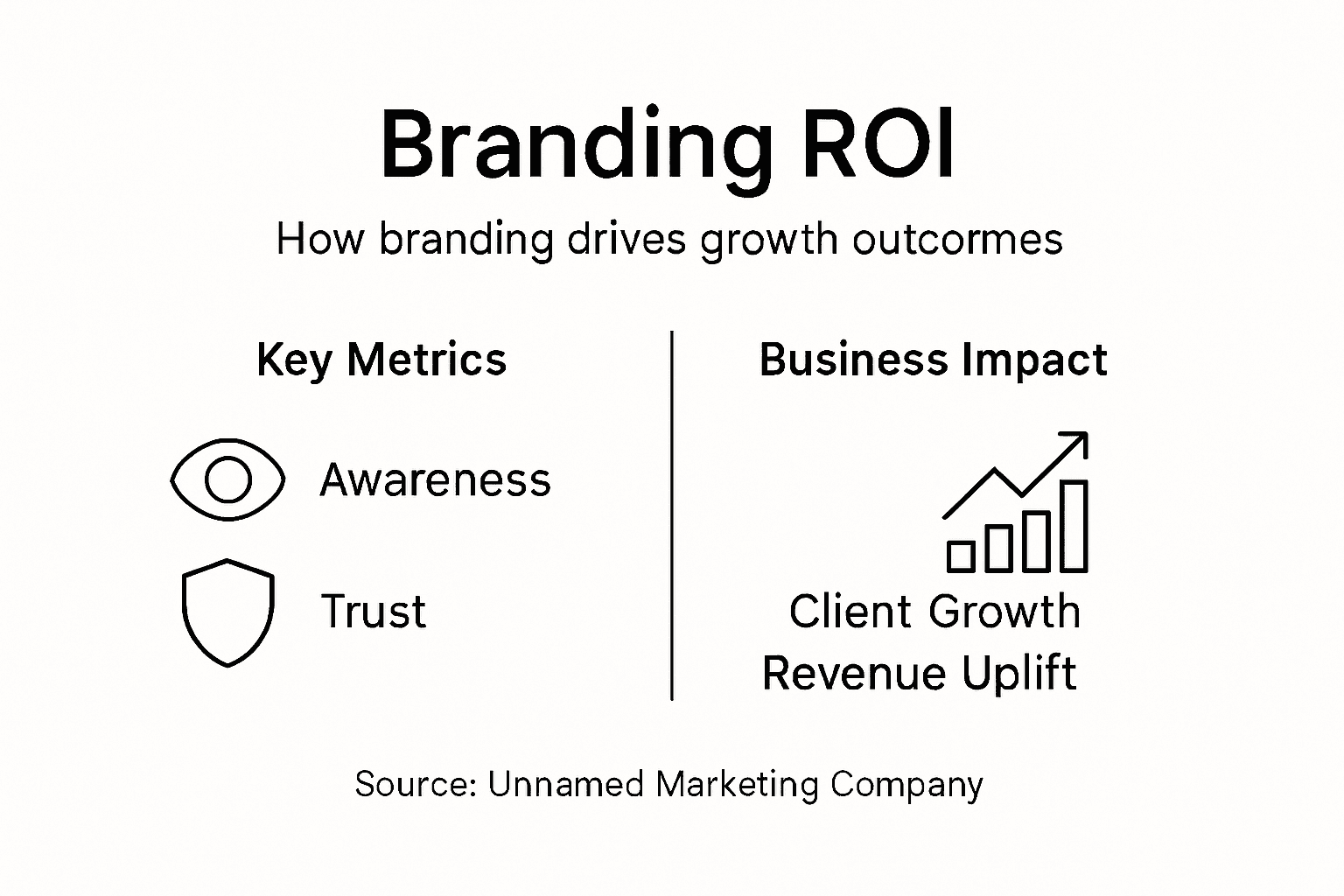
This table summarizes measurable branding ROI and the related business impact:
Growth Outcome | How Measured | Business Impact |
Revenue Enhancement | Pricing power, sales | Higher margins, expanded share |
Customer Acquisition | Cost efficiency | Lower marketing spend |
Loyalty Development | Retention rates | Stable recurring revenue |
Differentiation | Market positioning | Edge over competitors |
Shareholder Value | Stock valuation | Attracts investment |
Pro tip: Develop a comprehensive brand scorecard that tracks both quantitative financial metrics and qualitative brand perception indicators to gain a holistic view of your branding investments.
Risks of Neglecting Branding Investments
Brand investment negligence dramatically increases organizational vulnerability by exposing businesses to significant financial and competitive risks. When companies fail to strategically develop and maintain their brand identity, they become susceptible to market erosion, reduced customer loyalty, and diminished economic performance.
The critical risks of underinvesting in branding include:
Market Invisibility: Blending into competitive backgrounds
Reduced Customer Trust: Weakening emotional connections
Price Sensitivity: Losing ability to command premium pricing
Recruitment Challenges: Difficulty attracting top talent
Shareholder Perception: Negative financial market interpretations
Beyond financial metrics, neglecting brand development undermines organizational effectiveness across multiple operational dimensions. Poor brand management creates cascading negative effects, including decreased stakeholder engagement, lowered team morale, and reduced strategic adaptability in rapidly changing market environments.
Companies that treat branding as an optional expense rather than a critical investment expose themselves to substantial long-term risks. By failing to cultivate a strong, differentiated brand identity, organizations become vulnerable to competitive displacement, diminished market relevance, and increasingly sophisticated customer expectations.
Pro tip: Conduct an annual comprehensive brand audit to proactively identify and address potential brand vulnerability points before they become critical strategic risks.
Unlock Your Brand’s True Growth Potential Today
If you are struggling to build a distinctive identity that truly resonates with your customers or finding it difficult to connect your brand’s story with measurable business growth, you are not alone. Many businesses face the challenge of creating strategic brand alignment and emotional engagement that drives client acquisition and loyalty. With terms like brand equity, customer retention, and brand differentiation playing such vital roles, it’s easy to feel overwhelmed by where to start or how to invest wisely.
At Unnamed Marketing Company, we specialize in turning these complex branding concepts into clear, actionable strategies tailored to your unique goals. From crafting visual identities and compelling messaging frameworks to deploying interactive digital solutions, our expertise sits at the intersection of strategy, creativity, and performance. We invite you to explore our Digital Products that enhance brand engagement and deliver measurable ROI.

Don’t let your brand blend into the background. Partner with Unnamed Marketing Company to clarify your direction, build a strong brand foundation, and unlock sustainable growth. Start your transformation now by visiting our homepage and discover how our growth strategy and brand design services align with your vision for lasting impact.
Frequently Asked Questions
What is branding and why is it important?
Branding is the strategic process of creating a distinctive identity that communicates a company’s core values and differentiates it from competitors. It is important because a strong brand builds trust, enhances consumer recognition, and can lead to competitive advantages and customer loyalty.
How does effective branding impact financial performance?
Effective branding creates robust brand equity that can enhance business performance by allowing companies to command premium pricing, reduce customer acquisition costs, and improve customer retention rates, ultimately leading to increased revenue and market share.
What are the different types of branding strategies?
The main types of branding strategies include functional branding (focusing on product benefits), symbolic branding (emphasizing emotional connections), experiential branding (creating immersive interactions), corporate branding (representing the overall organization), product branding (targeting specific offerings), and service branding (highlighting unique service qualities).
How can businesses measure the ROI of their branding investments?
Businesses can measure branding ROI through various indicators, including revenue enhancement, customer acquisition costs, loyalty development, competitive differentiation, and shareholder value, allowing organizations to assess the economic impact and effectiveness of their branding strategies.
Recommended

Comments