


_edited.png)
Defining Brand Purpose: Driving Growth and Loyalty

Many Canadian marketing directors face the challenge of moving beyond surface-level messaging when defining their brand’s core purpose. The risk of mistaking brand purpose for a simple marketing tool can stall genuine growth and market expansion. Strengthening your brand purpose means embracing a deeper organizational commitment that fuels long-term strategy and creates authentic stakeholder value. This guide highlights proven frameworks and common misconceptions, helping you build a foundation that drives sustainable business advantage.
Table of Contents
Key Takeaways
Point | Details |
Brand Purpose Is Fundamental | Brand purpose goes beyond profit generation; it defines the core motivations and societal contributions of an organization. |
Misconceptions Must Be Addressed | Many view brand purpose as a marketing tool rather than a holistic, systemic commitment integrated into operations. |
Strategic Alignment Is Crucial | Ensuring that mission, values, and vision are aligned with brand purpose is essential for long-term success and authenticity. |
Measure and Evolve Purpose | Organizations must develop clear metrics to evaluate the impact of their brand purpose and adapt over time to maintain relevance. |
Brand Purpose Explained and Key Misconceptions
Brand purpose represents more than a corporate slogan or marketing tactic. It’s the fundamental reason an organization exists beyond generating profit, capturing the core motivations that drive a company’s strategic decisions and cultural identity.
Research reveals brand purpose operates across multiple dimensions, extending far beyond traditional business objectives. Academic frameworks demonstrate that effective brand purpose integrates consumer empowerment with broader social transformation strategies.
Key elements of a robust brand purpose typically include:
Transcending pure financial metrics
Creating meaningful stakeholder value
Aligning organizational values with societal needs
Generating authentic social impact
Developing a sustainable long-term vision
Most organizations misunderstand brand purpose as merely a public relations exercise. The reality is more nuanced. Genuine brand purpose requires deep commitment, transparent implementation, and consistent demonstration through business practices.
Misconceptions About Brand Purpose:
Brand purpose is just a marketing campaign
Purpose can be fabricated without systemic change
Financial performance and purpose are mutually exclusive
Purpose only matters for consumer-facing brands
Actionable Purpose Development involves systematic exploration of an organization’s core motivations, potential societal contributions, and authentic differentiation strategies.
Pro tip: Develop your brand purpose through collaborative internal workshops that engage team members across different organizational levels and perspectives.
Distinctions: Mission, Values, and Brand Purpose
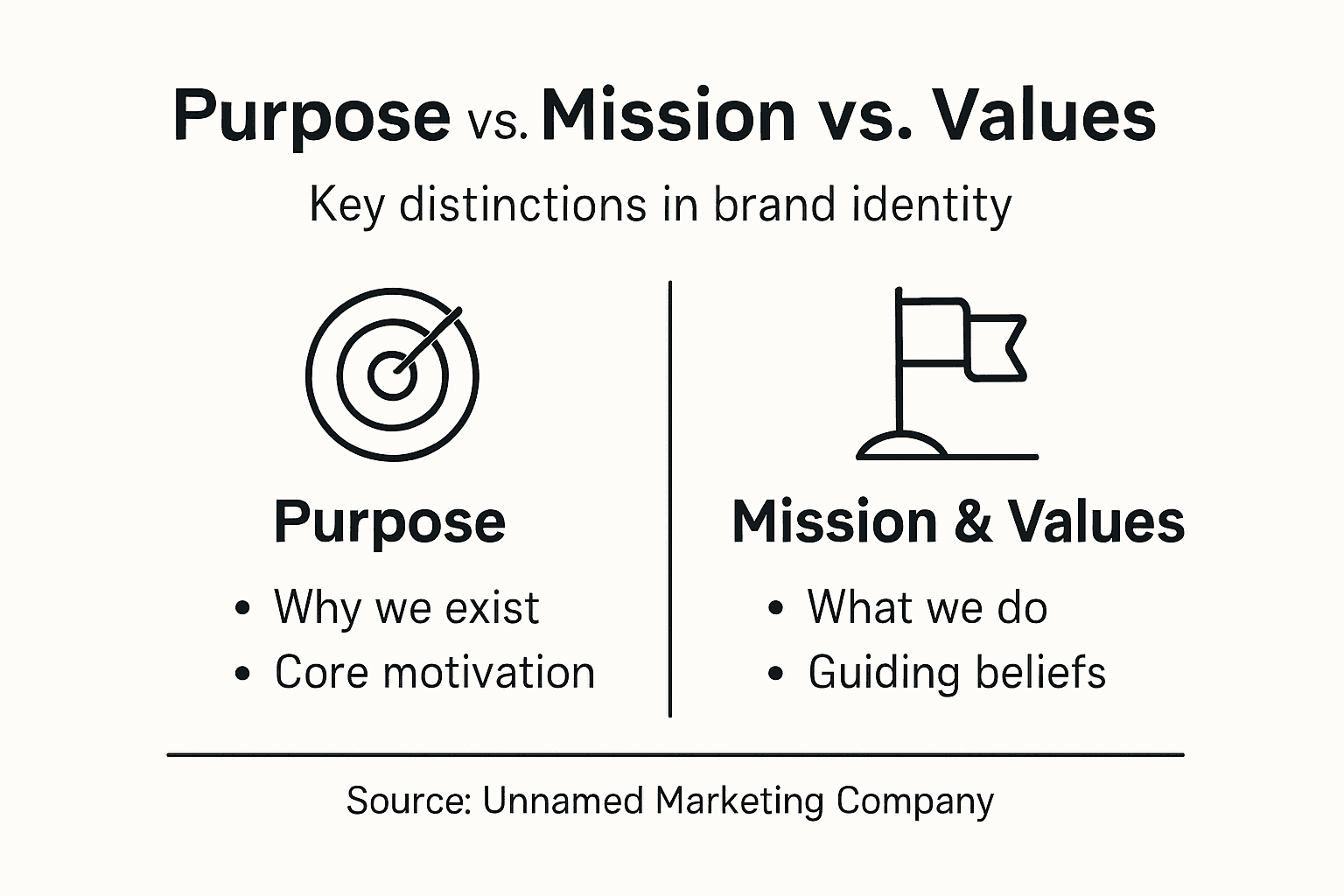
Brand purpose, mission, and values are interconnected yet distinct strategic elements that guide organizational identity and direction. While often used interchangeably, each concept serves a unique function in shaping a company’s strategic framework.

Strategic frameworks clarify organizational distinctions by defining clear roles for purpose, mission, and values. Mission articulates specific operational objectives, values establish behavioral standards, and brand purpose represents the deeper existential motivation driving the organization’s existence.
Key Differences Between Organizational Concepts:
Mission: Specific operational goals and immediate strategic objectives
Values: Guiding principles and behavioral expectations
Brand Purpose: Fundamental reason for organizational existence beyond profit
Vision: Long-term aspirational outlook for the organization
Most companies struggle to differentiate these concepts effectively. A robust organizational strategy requires understanding how each element interconnects and supports the others. Brand purpose serves as the foundational inspiration, mission provides the roadmap, values establish the behavioral guardrails, and vision sets the ultimate destination.
Practical Implementation Hierarchy:
Here’s how brand purpose, mission, values, and vision interrelate:
Strategic Element | Core Focus | Role in Organization | Time Horizon |
Brand Purpose | Deeper organizational reason | Inspires and guides all strategy | Long-term/Timeless |
Mission | Specific goals and actions | Provides direction for operations | Near- to mid-term |
Values | Ethical standards | Shapes daily behavior and culture | Ongoing |
Vision | Future aspirations | Defines long-term destination | Long-term |
Define overarching brand purpose
Develop mission aligned with purpose
Establish values supporting purpose and mission
Create vision reflecting long-term aspirations
Brand purpose transcends transactional goals, representing a deeper commitment to meaningful societal contribution.
Pro tip: Conduct annual strategic alignment workshops to ensure your mission, values, and brand purpose remain coherently interconnected and relevant.
Defining and Embedding Brand Purpose
Defining a meaningful brand purpose goes beyond crafting a simple mission statement. It requires deep introspection into an organization’s core motivations, societal contributions, and authentic strategic direction. Comprehensive organizational frameworks demonstrate that effective brand purpose integrates genuine commitment with actionable strategies.
Key Components of Defining Brand Purpose:
Identifying core organizational motivations
Understanding broader societal impact
Aligning purpose with business capabilities
Connecting emotional and strategic dimensions
Ensuring authenticity and long-term commitment
Successful brand purpose development requires a systematic approach that transcends traditional corporate messaging. Authentic brand purpose emerges from understanding an organization’s unique strengths, cultural context, and potential for meaningful contribution.
Practical Embedding Strategies:
Conduct comprehensive internal stakeholder workshops
Map organizational capabilities to societal needs
Develop clear communication frameworks
Create measurable impact metrics
Integrate purpose into operational processes
Brand purpose is not a marketing tactic, but a fundamental organizational philosophy that guides strategic decision-making.
Pro tip: Create a cross-functional team responsible for continuously monitoring and evolving your brand purpose to ensure ongoing relevance and authenticity.
Real-World Impact and Competitive Advantage
Brand purpose transforms from abstract concept to strategic differentiator when organizations understand its profound marketplace implications. Consumer trust research demonstrates that purposeful brands generate deeper connections and sustainable competitive advantages beyond traditional marketing approaches.
Competitive Advantages of Purpose-Driven Branding:
Enhanced consumer loyalty
Stronger emotional brand connections
Increased stakeholder engagement
Improved brand differentiation
Higher perceived organizational authenticity
Purpose-driven organizations outperform competitors by creating meaningful narratives that resonate with modern consumers’ expectations. Strategic brand purpose goes beyond profit generation, positioning companies as agents of positive societal transformation while simultaneously driving business performance.
Key Measurement Dimensions:
Consumer perception and trust levels
Employee engagement and retention
Market share and brand equity growth
Long-term financial performance
Social impact and stakeholder relationships
Purpose is not a marketing strategy, but a fundamental organizational philosophy that drives sustainable competitive advantage.
Pro tip: Develop comprehensive metrics that quantify both financial and social impact to demonstrate the tangible value of your brand purpose.
Risks, Pitfalls, and What to Avoid
Brand purpose implementation is fraught with potential missteps that can undermine organizational credibility and strategic effectiveness. Strategic research reveals critical branding risks that companies must navigate carefully to maintain authenticity and stakeholder trust.
Common Brand Purpose Pitfalls:
Superficial commitment without systemic change
Disconnection between stated purpose and actual practices
Lack of measurable impact metrics
Inconsistent communication across organizational levels
Performative social responsibility initiatives
Purpose-washing represents a significant risk where organizations create cosmetic narratives without substantive organizational transformation. Authentic brand purpose requires deep, structural integration that goes beyond marketing messaging and demonstrates genuine commitment through consistent actions and measurable outcomes.
Common pitfalls and solutions for brand purpose implementation:
Challenge | Why It Occurs | Effective Solution |
Superficial commitment | Lack of true leadership support | Ensure executive buy-in |
Poor measurement | No clear impact metrics | Define KPIs for purpose outcomes |
Inconsistent communication | Siloed messaging or priorities | Integrate purpose in all channels |
Disconnect from action | Misalignment with operations | Align purpose with business process |
Purpose-washing risk | Focus on image over substance | Conduct external authenticity audits |
Risks of Ineffective Brand Purpose:
Eroded consumer trust
Reduced employee engagement
Potential reputational damage
Diminished competitive positioning
Skepticism from critical stakeholders
Authenticity cannot be manufactured; it must be systematically built through consistent, transparent organizational practices.
Pro tip: Conduct regular third-party audits of your brand purpose implementation to ensure genuine alignment between organizational rhetoric and actual performance.
Unlock the Power of Authentic Brand Purpose to Fuel Growth and Loyalty
Struggling to define a brand purpose that truly inspires your team and resonates with your audience? This article explains how authentic brand purpose goes beyond marketing catchphrases to deliver measurable growth, consumer trust, and long-term loyalty. If you are facing challenges aligning your brand’s deeper mission with operational goals or avoiding common pitfalls like superficial commitment and inconsistent messaging this is your moment to act. At Unnamed Marketing Company, we specialize in crafting strategic frameworks that connect your brand purpose with clear execution plans.
Explore our Digital Products | Unnamed Marketing Company to discover tools designed to embed meaningful brand purpose into your marketing and growth strategies.

Elevate your brand by partnering with Unnamed Marketing Company. Visit https://unnamedmarketingcompany.com to learn how our expertise in growth strategy, brand design, and marketing planning can help you build an authentic purpose that drives lasting impact and competitive advantage. Start transforming your brand purpose into real-world results today.
Frequently Asked Questions
What is brand purpose?
Brand purpose is the fundamental reason an organization exists beyond just making a profit; it encompasses the company’s core motivations and cultural identity.
How does brand purpose impact customer loyalty?
A well-defined brand purpose fosters deeper emotional connections with customers, building trust and loyalty that can lead to long-term relationships and increased customer retention.
What are some common misconceptions about brand purpose?
Many people mistakenly think brand purpose is just a marketing tactic, can be fabricated without real change, or that it only applies to consumer-facing brands. In reality, it requires genuine commitment and alignment across the organization.
How can a business effectively develop its brand purpose?
Businesses can develop brand purpose by conducting internal workshops, exploring their core motivations, aligning capabilities with societal needs, and ensuring their purpose is authentic and measurable.
Recommended
Maximizing Your Marketing Return on Investment: A Step-by-Step Guide
: “The Importance of a Strong Brand Identity for Small Businesses”
The Truth About ROI: How to Actually Measure Your Marketing Success in 2025
Are You Ready to Scale? The Marketing Strategy Checklist Every $500K+ Business Needs
Lus Hair Care: Transforming Hair Through AI Insights | MyHair

Comments