


_edited.png)
Marketing Alignment: Unlocking SaaS Growth Potential

What happens when marketing efforts feel disconnected from sales goals or product strategy? For many North American SaaS leaders, siloed teams and unclear objectives can limit growth and create missed opportunities. Marketing alignment reshapes this challenge, connecting departments with shared metrics and integrated communication to drive lasting business results. This article offers practical strategies for transforming collaboration and building a unified path to organizational success.
Table of Contents
Key Takeaways
Point | Details |
Marketing alignment enhances growth | Strategic alignment of marketing with business objectives fosters sustainable growth and improves operational efficiency. |
Cross-team collaboration is essential | Effective marketing alignment requires transparent communication and defined roles across departments to achieve shared organizational goals. |
Continuous realignment is necessary | Regular assessments and workshops ensure marketing strategies adapt to changing business dynamics and market conditions. |
Avoid common pitfalls | Misalignment leads to inefficiencies; creating shared metrics and maintaining open communication can prevent costly mistakes. |
Defining Marketing Alignment in SaaS
Marketing alignment represents the strategic coordination between marketing efforts, business objectives, and organizational goals within software-as-a-service (SaaS) companies. At its core, this concept transforms marketing from a standalone function into a powerful collaborative engine driving sustainable growth.
In the SaaS ecosystem, marketing alignment goes beyond traditional departmental boundaries. It involves creating a cohesive approach where marketing strategies directly support and integrate with:
Sales targets and revenue objectives
Product development roadmaps
Customer experience expectations
Overall business strategy
Successful marketing alignment requires breaking down internal silos and establishing clear communication channels. This means marketing teams must work closely with product, sales, and customer success departments to create a unified narrative that resonates throughout the customer journey.
Marketing alignment transforms disconnected activities into a synchronized growth mechanism for SaaS businesses.
The fundamental components of effective marketing alignment in SaaS include:
Shared performance metrics
Cross-functional goal setting
Integrated communication strategies
Consistent brand messaging
Data-driven decision making
By implementing a strategic marketing approach, SaaS companies can ensure that every marketing initiative contributes directly to broader organizational objectives. This approach minimizes wasted resources and maximizes the impact of marketing investments.
Pro tip: Conduct quarterly cross-departmental workshops to review and realign marketing strategies with current business goals and market dynamics.
Distinct Types of Marketing Alignment Strategies
Marketing alignment strategies in SaaS companies are not one-size-fits-all approaches. Instead, they represent nuanced frameworks designed to synchronize different organizational components and drive strategic objectives.
Marketing alignment strategies can be categorized into several distinct types based on their primary focus and implementation approach:
Operational Alignment: Focuses on day-to-day coordination between marketing, sales, and product teams
Strategic Alignment: Connects long-term business goals with marketing initiatives
Technological Alignment: Integrates marketing tools and data systems across departments
Cultural Alignment: Develops shared values and communication practices
Strategic alignment within organizations occurs at multiple interconnected levels, requiring interdependence and collaborative leadership to execute new strategies effectively.
The most sophisticated SaaS companies typically employ a multi-dimensional approach to marketing alignment. This means simultaneously addressing operational, technological, and cultural dimensions to create a holistic strategy that transcends traditional departmental boundaries.

Here’s a comparison of key marketing alignment strategies applied in SaaS organizations:
Strategy Type | Primary Focus | Typical Outcome |
Operational Alignment | Streamlining daily cross-team tasks | Faster campaign execution |
Strategic Alignment | Linking marketing to business goals | Higher overall growth alignment |
Technological Alignment | Unifying tools and data systems | Improved analytics and reporting |
Cultural Alignment | Building shared values and behaviors | Stronger organizational cohesion |
Marketing alignment is not a destination, but a continuous journey of strategic coordination and collaborative execution.
Key considerations for implementing effective marketing alignment strategies include:
Establishing clear, shared performance metrics
Creating cross-functional communication channels
Developing integrated technology ecosystems
Fostering a collaborative organizational culture
Implementing continuous feedback mechanisms
By understanding and strategically applying these alignment approaches, SaaS companies can transform marketing from a siloed function into a powerful, integrated growth engine.
Pro tip: Conduct quarterly cross-functional workshops to assess and recalibrate your marketing alignment strategies, ensuring ongoing adaptability and strategic synchronization.
How Alignment Drives Growth and Performance
Marketing alignment is not just a theoretical concept but a tangible driver of business growth and performance for SaaS companies. When implemented strategically, alignment transforms organizational potential into measurable competitive advantage.
Performance drivers emerge from well-executed marketing alignment through multiple interconnected mechanisms:
Streamlined communication channels
Reduced internal friction
Accelerated decision-making processes
Enhanced resource allocation
Improved customer experience consistency
SaaS growth requires embedding alignment into product design, strategic partnerships, and cross-functional team dynamics. Success depends on understanding stakeholder needs and building trusted collaborative environments.
The most successful SaaS organizations recognize that alignment directly impacts key performance metrics. By synchronizing marketing efforts with broader organizational objectives, companies can create a powerful momentum that drives sustainable growth and competitive differentiation.
Alignment transforms disconnected activities into a unified strategic engine, propelling business performance beyond traditional limitations.
Critical performance metrics influenced by effective marketing alignment include:
Net revenue retention
Customer acquisition cost
Sales cycle efficiency
Cross-departmental productivity
Market penetration velocity
Companies that master marketing alignment can expect significant performance improvements, typically seeing enhanced operational efficiency and more predictable revenue streams.
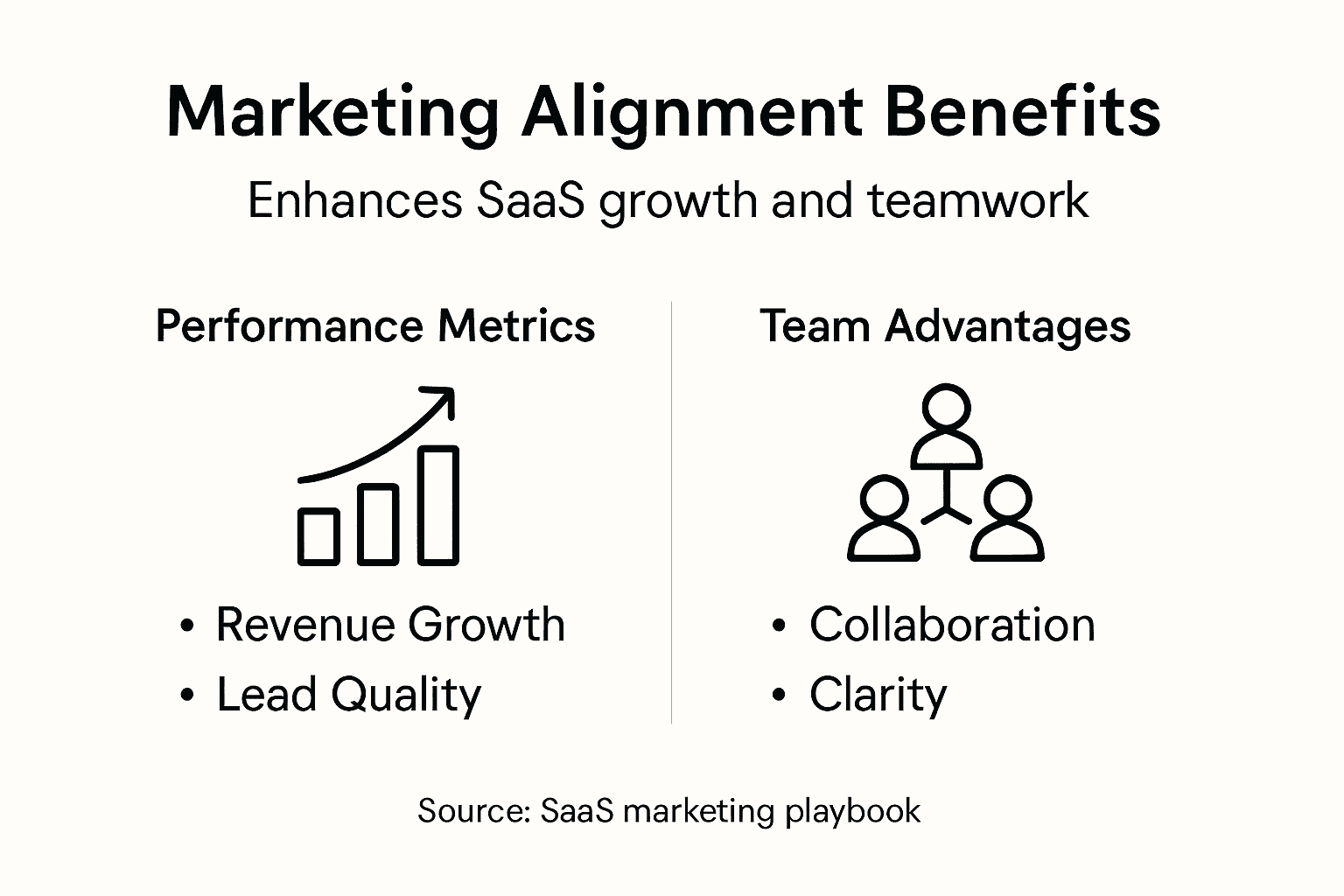
Below is a summary of marketing alignment’s impact on crucial SaaS performance metrics:
Metric | Influence of Alignment | Business Benefit |
Net Revenue Retention | Maintains coordinated upsell/renewal focus | More recurring revenue |
Customer Acquisition Cost | Optimizes resource allocation | Lower acquisition expenditures |
Sales Cycle Efficiency | Streamlines lead handoffs and communication | Shorter sales cycles |
Productivity | Reduces duplicated efforts across teams | Higher output with fewer errors |
Market Penetration Velocity | Aligns brand and sales for faster growth | Accelerated market expansion |
Pro tip: Develop a quarterly cross-functional scorecard that tracks alignment-related performance metrics to maintain strategic focus and continuous improvement.
Roles and Responsibilities in Cross-Team Collaboration
Cross-team collaboration in SaaS organizations requires a strategic approach to defining roles, responsibilities, and interdepartmental interactions. Successful implementation depends on creating clear expectations and establishing transparent communication frameworks.
Key collaborative roles in marketing alignment typically include:
Marketing Leaders: Strategic vision and cross-functional coordination
Sales Representatives: Customer insights and revenue feedback
Product Managers: Technical roadmap and feature alignment
Customer Success Managers: User experience and retention perspectives
Data Analysts: Performance measurement and insights generation
Cross-team collaboration involves independent teams coordinating to achieve shared outcomes through clear goals, open communication, and collaborative tools. This approach combines diverse perspectives without merging entire organizational structures.
Effective role definition goes beyond traditional job descriptions. Each team member must understand their specific contribution to the broader organizational objectives while maintaining flexibility to adapt and support collective goals.
Successful cross-team collaboration transforms individual expertise into a unified organizational intelligence.
Critical responsibilities for effective marketing alignment include:
Establishing shared performance metrics
Maintaining transparent communication channels
Resolving interdepartmental conflicts constructively
Sharing relevant insights and data
Continuously realigning strategies
Companies that master cross-team collaboration create an adaptive ecosystem where information flows seamlessly, enabling rapid response to market changes and customer needs.
Pro tip: Implement quarterly role-clarity workshops to review and refine team responsibilities, ensuring ongoing alignment and collaborative effectiveness.
Risks, Costs, and Common Alignment Mistakes
Marketing alignment in SaaS companies is complex and fraught with potential pitfalls that can significantly undermine organizational effectiveness. Understanding these risks is crucial for developing proactive strategies that mitigate potential performance challenges.
Common alignment risks include:
Misaligned departmental objectives
Inconsistent communication protocols
Lack of shared performance metrics
Siloed decision-making processes
Inadequate technology integration
Common SaaS scaling mistakes often stem from premature scaling and neglecting long-term architectural and process requirements. These errors can dramatically increase operational friction and technical debt.
The financial implications of poor marketing alignment can be substantial. Misalignment creates inefficiencies that translate into higher operational costs, reduced productivity, and missed revenue opportunities. Organizations might spend significant resources addressing symptoms rather than underlying structural problems.
Marketing misalignment is a silent revenue killer that erodes competitive advantage from within.
Key alignment mistakes that SaaS companies frequently encounter include:
Treating departments as independent entities
Failing to establish clear communication channels
Neglecting continuous performance feedback
Overlooking cultural integration
Resisting adaptive strategy development
Successful SaaS organizations recognize that alignment is an ongoing process requiring constant attention, investment, and strategic recalibration.
Pro tip: Conduct bi-annual comprehensive alignment audits to identify and proactively address emerging organizational disconnects.
Drive Your SaaS Growth with Strategic Marketing Alignment
Many SaaS companies struggle with misaligned marketing efforts that lead to wasted resources and slower growth. This article highlights the importance of aligning marketing strategies with sales, product development, and customer success to unlock growth potential. If your business faces challenges like unclear performance metrics, siloed teams, or inconsistent communication, finding a partner who understands these hurdles can make all the difference.
At Unnamed Marketing Company, we specialize in designing and implementing growth strategies that unify your teams around shared goals. Our expertise at the intersection of strategy, creativity, and performance helps SaaS companies move beyond theory to actionable alignment that accelerates results. Discover our Digital Products | Unnamed Marketing Company offerings designed specifically to support integrated marketing efforts.

Take control of your SaaS growth with proven alignment frameworks and expert guidance. Visit Unnamed Marketing Company today to learn how we help businesses like yours plan, position, and scale with intention. Explore strategic marketing solutions that turn scattered efforts into a synchronized growth engine and start seeing real-world results now.
Frequently Asked Questions
What is marketing alignment in SaaS?
Marketing alignment in SaaS refers to the strategic coordination between marketing efforts, business objectives, and organizational goals, transforming marketing from a standalone function into a collaborative engine that drives growth.
How does marketing alignment impact SaaS growth?
Effective marketing alignment enhances communication, reduces friction, and streamlines processes across departments, leading to improved performance metrics such as customer acquisition cost and net revenue retention, ultimately facilitating sustainable growth.
What are the key components of successful marketing alignment?
The key components include shared performance metrics, cross-functional goal setting, integrated communication strategies, consistent brand messaging, and data-driven decision-making.
What common mistakes do SaaS companies make regarding marketing alignment?
Common mistakes include treating departments as independent entities, failing to establish clear communication channels, neglecting continuous performance feedback, and resisting adaptive strategy development.
Recommended

Comments