


_edited.png)
Role of Brand Strategy for Service Firm Growth

Shaping a clear brand strategy is a constant challenge for Toronto professional service firms aiming to expand across North America. With fierce competition and market expectations always shifting, directors know that building lasting client relationships and precise positioning are key. By focusing on brand identity and targeted differentiation, firms can communicate expertise in ways that drive growth, loyalty, and recognition in the American and Canadian markets.
Table of Contents
Key Takeaways
Point | Details |
Importance of Brand Strategy | A robust brand strategy is essential for professional service firms to differentiate themselves and communicate their unique value effectively. |
Types of Brand Strategies | Service firms should employ external, internal, interactive, and relational marketing strategies to enhance their market positioning. |
Core Elements of Branding | Key elements such as brand identity, positioning, communication, and experience must be integrated for a compelling brand narrative. |
Common Execution Pitfalls | Avoid pitfalls like communication breakdowns and resource misalignment by ensuring strategic commitment and alignment across the organization. |
Defining Brand Strategy in Professional Services
A brand strategy represents the comprehensive roadmap that professional service firms use to differentiate themselves, communicate their unique value, and consistently position their organization in the competitive marketplace. Unlike product-based businesses, service firms must craft strategies that communicate expertise, trustworthiness, and specialized capabilities through intangible assets.
In professional services, brand strategy goes beyond visual identity, encompassing how firms build trust through market positioning. The core components include:
Defining core organizational values
Articulating unique service propositions
Understanding target client segments
Developing consistent communication frameworks
Creating meaningful brand differentiation
Successful brand strategies for professional service organizations require deep understanding of client needs, market dynamics, and the firm’s distinctive capabilities. These strategies must translate complex service offerings into compelling narratives that resonate with potential clients’ specific challenges and aspirations.
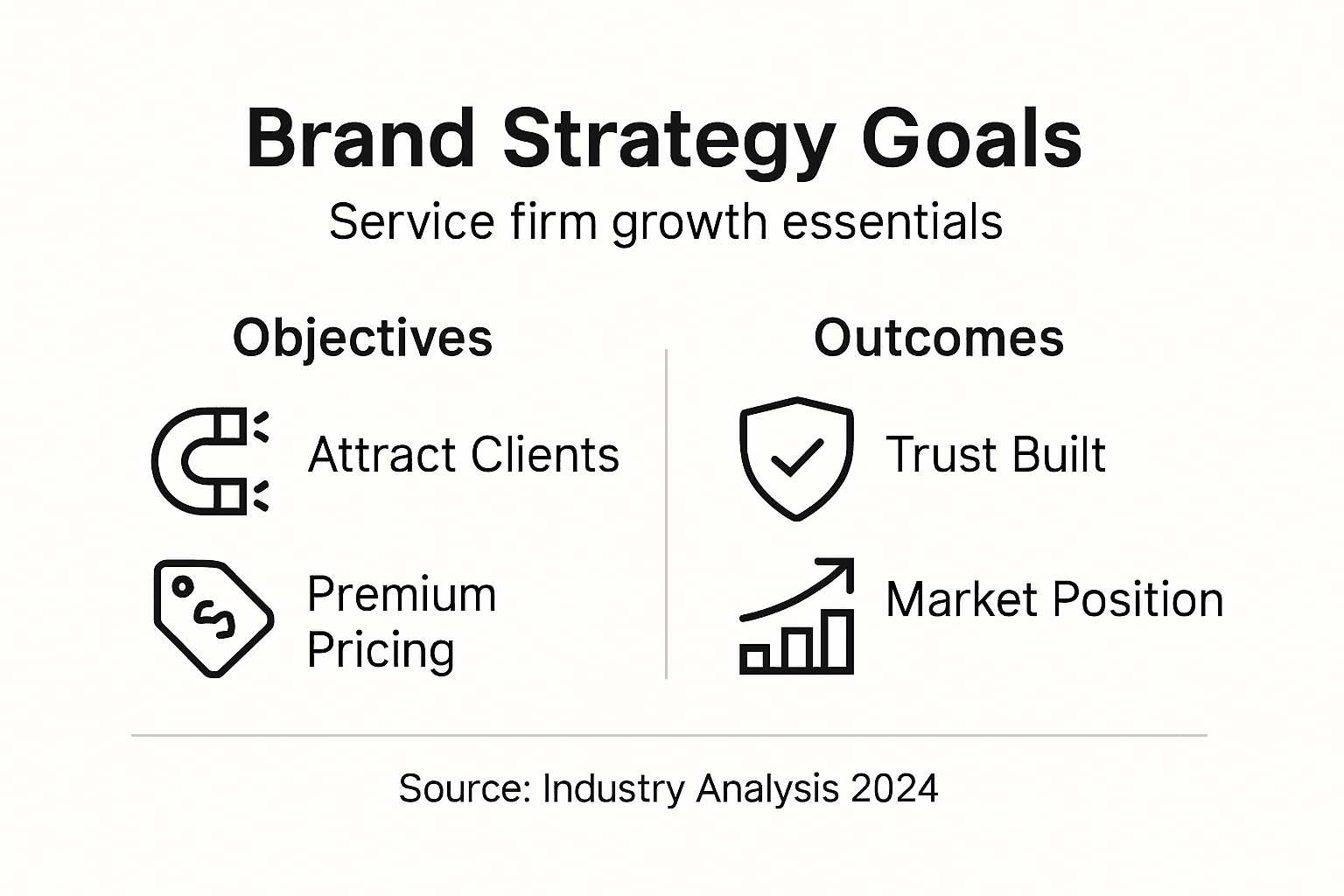
The primary objectives of a robust brand strategy include attracting high-value clients, commanding premium pricing, and establishing thought leadership within specific industry verticals. Professional service firms must strategically communicate their expertise, demonstrating specialized knowledge that sets them apart from generalist competitors.
Pro tip: Conduct annual brand audits to ensure your strategic positioning remains relevant and aligned with evolving market expectations and client preferences.
Types of Brand Strategies for Service Firms
Professional service firms leverage multiple strategic approaches to effectively communicate their unique value proposition and differentiate themselves in competitive markets. Strategic service marketing techniques reveal four fundamental brand strategy types that address the complex challenges of intangible service offerings.
The primary types of brand strategies for service firms include:
External Marketing Strategy
Focuses on broad consumer engagement
Develops comprehensive communication channels
Targets potential clients through multiple touchpoints
Internal Marketing Strategy
Aligns employees with organizational brand values
Creates consistent brand messaging across internal teams
Develops workforce understanding of brand promise
Interactive Marketing Strategy
Manages direct customer interactions
Shapes brand perception through service experiences
Emphasizes personalized client engagement
Relational Marketing Strategy
Builds long-term client relationships
Focuses on trust and repeated service delivery
Develops loyalty and recurring business models
These strategies recognize that service firms must overcome unique marketing challenges, including intangibility, variability, and the inseparable nature of service delivery. By crafting nuanced approaches that address these complexities, professional service organizations can create compelling brand narratives that resonate with their target markets.
Each strategy requires careful customization based on the firm’s specific industry, target audience, and competitive landscape. The most successful service firms integrate multiple strategic approaches, creating a holistic brand positioning that communicates expertise, reliability, and distinctive value.
Here’s how the four primary brand strategy types for service firms differ in focus and outcomes:
Strategy Type | Main Objective | Key Stakeholders | Example Outcome |
External Marketing | Attract new clients | Prospective clients | Increased market visibility |
Internal Marketing | Strengthen employee alignment | Employees, leadership | Unified brand messaging |
Interactive Marketing | Enhance service experience | Clients, front-line staff | Improved client satisfaction |
Relational Marketing | Build lasting client loyalty | Existing clients | Long-term engagement, referrals |
Pro tip: Regularly assess and recalibrate your brand strategy to ensure alignment with evolving market dynamics and client expectations.
Core Elements of Effective Brand Strategy
Developing a robust brand strategy demands a multidimensional approach that goes beyond superficial marketing tactics. Brand management strategies require comprehensive integration of several critical elements that collectively define a firm’s market positioning and competitive advantage.
The core elements of an effective brand strategy encompass:
Brand Identity
Articulates the organization’s core purpose
Defines unique value proposition
Communicates fundamental organizational values
Brand Positioning
Differentiates the firm in competitive markets
Highlights distinctive capabilities
Targets specific client segments strategically
Brand Communication
Develops consistent messaging across channels
Aligns internal and external communication
Creates cohesive narrative about organizational strengths
Brand Experience
Ensures consistent service delivery
Builds trust through predictable interactions
Generates positive emotional connections with clients
Successful brand strategies require continuous adaptation and alignment with evolving market dynamics. Professional service firms must view their brand strategy as a dynamic framework that responds to changing client expectations, technological advancements, and competitive landscapes.

The interconnection of these elements creates a powerful brand ecosystem that transcends traditional marketing approaches. By meticulously crafting and integrating these components, service firms can develop a compelling brand narrative that attracts high-value clients and establishes long-term market credibility.
The table below summarizes how key elements of brand strategy contribute to long-term business performance:
Element | Drives | Risk if Neglected |
Brand Identity | Clear market recognition | Brand confusion |
Brand Positioning | Competitive advantage | Undifferentiated offering |
Brand Communication | Trust and message consistency | Mixed signals to clients |
Brand Experience | Repeat business, loyalty | Negative client perception |
Pro tip: Conduct quarterly brand audits to assess strategy effectiveness and identify areas for strategic refinement.
Practical Applications in North American Markets
Professional service firms expanding into the North American market must develop nuanced brand strategies that reflect the region’s competitive landscape. Strategic brand positioning research reveals critical insights for successful market penetration and sustainable growth.
Key practical applications for North American markets include:
Specialized Service Positioning
Focus on narrow, expertise-driven branding
Develop deep competence in specific service niches
Demonstrate precise technical capabilities
Client Relationship Management
Build trust through consistent performance
Create targeted communication strategies
Develop long-term engagement models
Market Differentiation Techniques
Highlight unique organizational capabilities
Articulate distinctive problem-solving approaches
Leverage specific industry knowledge
Knowledge-Intensive Branding
Showcase intellectual capital
Develop thought leadership content
Demonstrate measurable client outcomes
Successful North American professional service firms recognize that brand strategy is not a static concept but a dynamic framework requiring continuous refinement. The most effective approaches combine deep specialization with flexible adaptation to evolving market demands.
Empirical evidence suggests that firms achieving sustainable competitive advantage prioritize precise brand positioning and maintain a clear understanding of their unique market value. By carefully aligning brand strategy with organizational strengths, service firms can effectively differentiate themselves in the competitive North American business environment.
Pro tip: Conduct annual market research to validate and recalibrate your brand positioning strategy for maximum relevance and impact.
Common Pitfalls in Brand Strategy Execution
Brand strategy implementation is fraught with challenges that can derail even the most meticulously planned approaches. Strategy execution pitfalls reveal critical areas where professional service firms frequently stumble during brand development and deployment.
Key common pitfalls in brand strategy execution include:
Communication Breakdowns
Lack of clear strategic messaging
Inconsistent communication across organizational levels
Failure to create shared understanding
Leadership Disconnection
Insufficient leadership engagement
Minimal involvement in strategy translation
Absence of strategic commitment
Resource Misalignment
Unrealistic resource planning
Inadequate budget allocation
Poor capability development
Organizational Culture Mismatches
Strategy incompatible with existing culture
Resistance to strategic changes
Lack of employee buy-in
Successful brand strategy execution demands more than theoretical planning. Professional service firms must create robust implementation mechanisms that transform strategic concepts into tangible organizational behaviors, ensuring consistent brand delivery across all touchpoints.
Overcoming these pitfalls requires a holistic approach that integrates strategic thinking with practical execution. Leaders must develop adaptive frameworks that allow for continuous refinement, creating flexible brand strategies capable of responding to evolving market dynamics.
Pro tip: Implement quarterly strategy review sessions to identify execution gaps and realign brand strategy with organizational capabilities.
Unlock Lasting Growth with a Strategic Brand Approach
Professional service firms often struggle with crafting a brand strategy that clearly communicates expertise and builds lasting client trust. This challenge includes aligning your brand identity with market positioning and ensuring consistency across all customer touchpoints. If your firm is seeking to overcome communication breakdowns, leadership disconnect, or resource misalignment, focusing on a multidimensional brand strategy is essential. Key concepts like brand identity, brand positioning, and relational marketing strategy from the article highlight how a specialized approach can fuel growth and client loyalty.
At Unnamed Marketing Company, we transform these crucial ideas into actionable results. Our expertise in growth strategy, marketing planning, and brand execution frameworks helps service firms like yours build a cohesive and compelling brand narrative that resonates with your target audience. Explore our Digital Products to find tools designed to clarify your direction and amplify your market presence.

Are you ready to elevate your service firm’s brand strategy and unlock sustainable growth? Visit Unnamed Marketing Company today to start crafting a brand that commands premium pricing and fosters long-term expertise recognition. Don’t wait – the path to intentional growth begins with aligning your brand strategy to real-world results.
Frequently Asked Questions
What is a brand strategy in professional services?
A brand strategy is a comprehensive roadmap that helps professional service firms differentiate themselves, communicate their unique value, and position their organization effectively in the market.
Why is brand strategy important for service firms?
Brand strategy is crucial for service firms as it helps to build trust, attract high-value clients, command premium pricing, and establish thought leadership within specific industries.
What are the core components of an effective brand strategy?
Core components of an effective brand strategy include defining organizational values, articulating unique service propositions, understanding target client segments, developing consistent communication frameworks, and creating meaningful brand differentiation.
How can a service firm assess its brand strategy’s effectiveness?
Service firms can assess their brand strategy’s effectiveness by conducting regular brand audits and market research to evaluate alignment with client expectations, market dynamics, and overall brand performance.
Recommended

Comments