


_edited.png)
Role of Marketing Consultancy: Driving Growth Outcomes
- Feb 23
- 10 min read

Facing growth plateaus and competitive pressure is a reality for many Toronto-based professional service firms. Without a clear strategy and true market understanding, efforts to stand out across North America often fall flat. This guide explains why specialized marketing consultancy delivers more than tactics—it offers objective insight, tailored frameworks, and the clarity needed to sharpen your positioning and drive measurable growth where it matters most.
Table of Contents
Key Takeaways
Point | Details |
Value of Marketing Consultancy | Marketing consultancy aligns business goals with market opportunities, providing clarity on competitive positioning and growth strategies. |
Importance of Strategic Focus | A clear strategic roadmap is essential; it brings measurable outcomes and guides effective execution of marketing efforts. |
Risks of Engagement | Engaging consultants without clear success metrics can lead to wasted resources and unclear results. |
Key Service Areas | Different areas of consultancy, such as strategy, branding, and digital marketing, require a tailored approach based on firm needs. |
Defining Marketing Consultancy and Its Value
Marketing consultancy is far more than hiring someone to manage your ads or create a social media calendar. It’s a specialized service that evolved from traditional market research into a comprehensive, data-driven approach to growth strategy. Consultants act as strategic advisors who align your business goals with real-world market opportunities.
Objective advisory services help organizations navigate strategic, organizational, and operational challenges by bringing external perspective and proven frameworks to your specific situation. For professional service firms, this means someone who understands your market dynamics, competitive pressures, and growth constraints.
At its core, marketing consultancy sits at the intersection of three critical functions:
Strategy: Defining where you want to go and why
Positioning: Clarifying how you’re different in a crowded market
Execution: Building the frameworks and systems to actually achieve growth
The real value emerges when consultants uncover what you’re missing. Maybe your positioning doesn’t reflect your actual market strength. Maybe you’re competing on price when clients value expertise. Maybe your growth strategy overlooks emerging service lines or geographic markets where you have untapped potential.
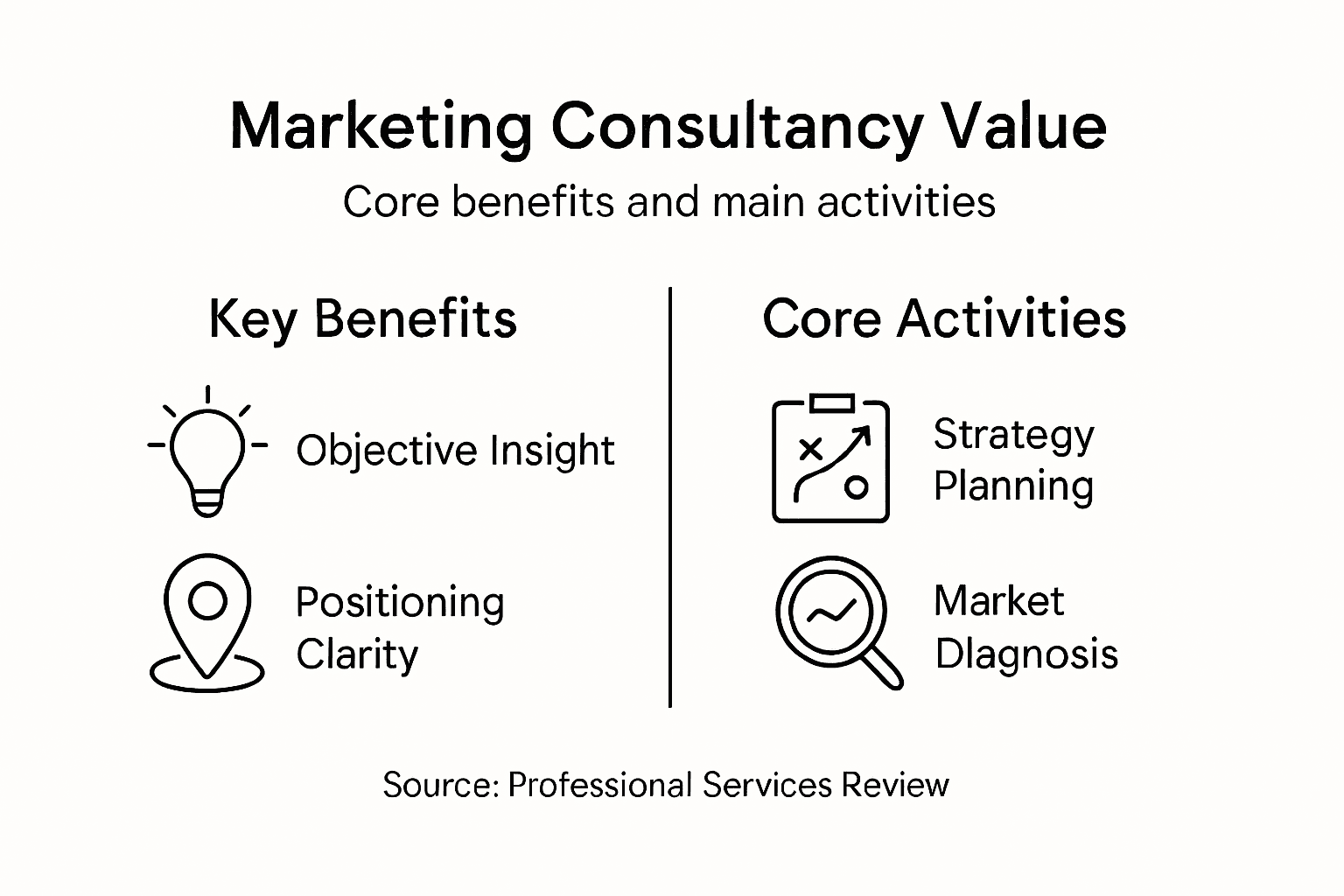
Data-driven marketing services help professional service firms differentiate and sustain competitive advantage in globalized, fragmented markets. This isn’t about applying generic playbooks. It’s about understanding your specific competitive position, your client acquisition patterns, and where your next growth comes from.
Consider what happens without this clarity. Many Toronto-based professional firms operate with vague positioning, inconsistent messaging across teams, and growth efforts that feel like throwing darts in the dark. Revenue plateaus. Talent struggles to articulate why clients should choose you. Marketing budgets get stretched across tactics rather than strategy.
The difference between consultancy and execution is simple: consultancy diagnoses the problem and designs the solution; execution makes it real.
A strong marketing consultancy partnership should give you:
Clarity on your actual competitive position
A roadmap aligned with your business objectives
Frameworks your team can execute against
Measurable outcomes tied to growth
Pro tip: Before engaging any consultancy, ask them to articulate your current market position without your input—their accuracy reveals whether they’ll actually drive growth or just deliver generic recommendations.
Consultancy Types and Key Service Areas
Marketing consultancy isn’t one-size-fits-all. Different firms need different expertise depending on where they stand and where they want to go. Understanding the main service categories helps you identify exactly what your organization needs.
Consultants typically organize their offerings into distinct service areas, though many firms offer hybrid approaches. The primary categories include strategy and planning, branding and positioning, digital marketing, market research, and sales enablement. Service diversification and hybrid delivery models have become standard as clients demand integrated solutions rather than siloed expertise.
Here’s what each service area covers:
Here’s how major marketing consultancy service areas differ in focus and business impact:
Service Area | Main Focus | Typical Tools/Methods | Impact for Firms |
Strategy & Planning | Growth roadmap, vision | Workshops, analysis, plans | Clear direction, smart goals |
Branding & Positioning | Unique market distinction | Brand audits, messaging | Higher perceived value |
Digital Marketing | Online presence | SEO, content, ads | Leads, broader audience reach |
Market Research | Market & client insights | Surveys, interviews, data | Informed decision-making |
Sales Enablement | Sales process alignment | Training, materials, scripts | Stronger win rates |
Strategy and Planning: Defining your growth roadmap, market positioning, and competitive differentiation. This is foundational work that informs everything else.
Branding: Crafting your visual identity, messaging framework, and brand narrative. For professional service firms, this often means clarifying what makes you fundamentally different.
Digital Marketing: Search optimization, content strategy, social presence, and digital channel management. Critical for reaching decision-makers in your target market.
Market Research: Understanding your competitive landscape, client needs, and emerging opportunities through data and insights.
Sales Strategy: Aligning your go-to-market approach with your positioning and equipping your team to sell effectively.
Digital marketing consulting leadership continues growing across North America, reflecting how essential digital channels have become for professional service firms. But digital alone doesn’t drive sustainable growth—it needs to be grounded in solid strategy and authentic brand positioning.
Most consultancies segment their service delivery by client size and industry. You’ll find that professional service firms often benefit from consultants who understand your specific vertical—whether that’s accounting, engineering, law, or management consulting. They recognize your sales cycles, your client decision-making patterns, and your operational constraints.
The best consultancy engagement combines strategic clarity with tactical execution support across multiple service areas simultaneously.
When evaluating consultancy options, consider whether you need single-service focus or integrated support. A firm rebranding while launching digital might need strategy, branding, and digital marketing working in tandem. A firm entering new geographic markets might prioritize market research and positioning before investing heavily in digital.
Pro tip: Ask potential consultants which service areas they’ve integrated successfully for firms similar to yours—their project examples reveal whether they can orchestrate multi-disciplinary work or just execute individual services.
How Marketing Consultants Plan and Execute
Planning and execution aren’t separate phases in effective consultancy—they’re deeply connected. A consultant’s job is to create a roadmap that your team can actually follow, then guide you through implementation with course corrections along the way.

The process typically starts with discovery and diagnosis. Consultants ask hard questions about your current position, competitive landscape, and growth constraints. This isn’t about assumptions; it’s about data. Problem identification and exploratory research form the foundation for everything that follows, ensuring strategies are grounded in real market insights rather than guesswork.
Once the diagnosis is clear, consultants move into strategy development. This is where they synthesize research findings into a coherent growth plan. For a Toronto-based professional service firm, this might mean identifying which service lines have the strongest market demand, where geographic expansion makes sense, or how to reposition against emerging competitors.
The planning phase includes:
Competitive positioning analysis
Target market segmentation and prioritization
Value proposition refinement
Go-to-market strategy and channel prioritization
Budget allocation and resource planning
Execution is where most strategies fail. A consultant’s role here is translating strategy into action frameworks that your team can execute consistently. This might include developing messaging guidelines, creating content calendars, establishing lead generation processes, or designing sales enablement materials.
Iterative collaboration matters tremendously during execution. Consultants refine objectives based on real-world feedback, adjust tactics when market conditions shift, and ensure your team has the skills and systems to sustain momentum. It’s not about the consultant doing the work—it’s about your team executing with consultant guidance.
The best consultants build capability in your organization, not dependency on their presence.
Effective execution requires clear accountability and measurable outcomes. Consultants establish key performance indicators tied to growth targets, create reporting dashboards, and conduct regular performance reviews. This transparency keeps everyone aligned and reveals where adjustments are needed.
Pro tip: During planning, ask consultants how they’ll transition you from their guidance to autonomous execution—firms that plan this handoff from day one build sustainable internal momentum rather than creating reliance.
Brand Positioning for Professional Service Firms
Brand positioning is where strategy becomes tangible. It’s not about your logo or color palette—it’s about the specific promise you make to clients and how that promise differentiates you from competitors. For professional service firms, positioning is often the difference between commodity pricing and premium value.
Many professional service firms struggle with positioning because they try to be everything to everyone. You offer accounting, tax planning, and audit services. You serve both startups and established corporations. You operate in multiple cities. The temptation is to position broadly to capture more clients. This rarely works.
Specialized, narrow branding correlates strongly with firm performance in the services sector. Firms that stake a clear claim—whether that’s “the firm for high-growth tech companies” or “the trusted advisor for family office wealth management”—outperform generalists. This focus protects competitive advantage and drives better financial outcomes.
Effective positioning for your firm should address:
Who you serve best: Your ideal client profile, not everyone
What you do differently: Your distinctive approach or methodology
Why it matters: The specific outcomes clients achieve working with you
What you don’t do: The clarity of what’s out of scope
For a Toronto-based firm, geographic positioning matters too. Are you the local expert with deep community relationships, or the North American player with global resources? Both positions work—but you can’t convincingly be both simultaneously.
Consultants help translate positioning into consistent messaging across all touchpoints. Your website, proposal templates, team bios, and client conversations should reinforce the same positioning. When they don’t align, clients sense inconsistency and doubt your clarity.
Positioning without consistent execution across your organization is just marketing copy with no credibility.
The toughest part of positioning is the decisions it requires. A clear position means saying no. You decline projects outside your niche. You invest marketing budget in your target market, not broadly. You hire team members who fit your positioning, not just fill seats.
Pro tip: Test your positioning with your best clients—ask them to articulate what makes you different without referencing your marketing materials; their answers reveal whether your positioning is actually integrated into your brand experience.
Risks, Costs, and Common Engagement Mistakes
Marketing consultancy isn’t risk-free. Bad engagements waste money, distract your team, and leave you more confused than when you started. Understanding what can go wrong helps you avoid the most common pitfalls.
The biggest risk is hiring consultants without clarity on what success looks like. Many firms bring in consultants to solve vague problems: “Our marketing isn’t working” or “We need to grow faster.” Without specific objectives, consultants chase recommendations rather than results. You end up with a beautiful strategy document that sits on a shelf.
Cost is another legitimate concern. Quality consultancy isn’t cheap. You might invest $15,000 to $75,000 for a comprehensive growth strategy engagement, depending on scope and firm size. Some firms charge hourly rates of $150 to $400+ per hour. These aren’t trivial investments, which makes it critical to understand what you’re paying for.
Common engagement mistakes include:
Unclear success metrics: No definition of what “success” means in measurable terms
Limited internal buy-in: Leadership isn’t aligned on consultancy value before engagement starts
Expecting the consultant to execute: Hiring consultants to do the work rather than guide your team
Short engagement windows: Expecting strategy and execution in six weeks
Ignoring handoff planning: No plan for how your team takes ownership after consultants leave
Another risk is consultants recommending tactics instead of strategy. Some consultancies are really execution firms dressed up as strategists. They’ll design your website, manage your LinkedIn, or run your paid ads—all valuable services, but not consultancy. Understanding marketing success measurement is crucial before engagement so you can distinguish between tactical execution and strategic advisory.
The riskiest consultancy engagement is one where you don’t know exactly what you’re paying for or what success looks like when you’re done.
A few protections reduce risk significantly. Get clear contracts specifying deliverables, timelines, and success metrics. Involve your leadership team in consultant meetings so they understand the work and own the recommendations. Set clear boundaries on consultant scope to avoid open-ended engagements.
To avoid costly mistakes, compare these common consultancy engagement pitfalls and prevention strategies:
Mistake | Why It Happens | Simple Prevention |
Vague success criteria | Goals not defined clearly | Set measurable outcomes |
Poor leadership buy-in | Lack of upfront involvement | Include leaders from start |
Over-reliance on consultants | Expecting them to execute alone | Build internal capability |
Unplanned handover | No transition strategy | Plan for team ownership |
Tactical-only recommendations | Consultant lacks strategic focus | Request case study evidence |
Pro tip: Before signing a consulting agreement, ask for a sample deliverable or project summary from similar engagements; this reveals whether consultants focus on strategy and insight or just tactical recommendations.
Unlock Growth with Strategic Marketing Consultancy
Struggling to define your firm’s unique positioning or to turn marketing strategy into measurable growth? Many professional service firms face unclear competitive advantage and inconsistent execution that stall progress. This article highlights how effective marketing consultancy can provide clarity on your market position, a roadmap aligned with business goals, and frameworks for sustainable execution to overcome these challenges.
At Unnamed Marketing Company, we understand the importance of combining strategy, creativity, and performance to help businesses thrive. From crafting precise growth plans to building authentic brand narratives and implementing powerful digital strategies, our team specializes in services that deliver real results. Explore our Digital Products to see how integrated, data-driven solutions can elevate your market impact.

Ready to move beyond vague tactics and achieve measurable, sustainable growth? Visit Unnamed Marketing Company today to discover how our strategic growth and brand consultancy can help you plan, position, and scale with confidence. Take the next step to clarify your direction and build a brand that truly stands out.
Frequently Asked Questions
What is marketing consultancy?
Marketing consultancy is a specialized service that provides strategic advice to align business goals with market opportunities, focusing on strategy, positioning, and execution for growth.
How can marketing consultancy help my firm?
Marketing consultancy can uncover market insights, improve your positioning, craft a clear growth strategy, and help implement effective marketing frameworks that lead to measurable outcomes.
What are the key areas of focus for marketing consultancy services?
Key areas include strategy and planning, branding and positioning, digital marketing, market research, and sales enablement, each tailored to meet the specific needs of your organization.
What should I consider before hiring a marketing consultant?
Before hiring a consultant, define clear success metrics for the engagement, assess their understanding of your industry, and evaluate their ability to transition your team from reliance on their guidance to autonomous execution.
Recommended

Comments