


_edited.png)
Why Align Marketing and Sales for Growth Impact
- Feb 18
- 6 min read

Every marketing manager experiences the friction that arises when sales and marketing teams work in silos across Toronto firms. This divide slows down customer acquisition and weakens retention, undermining shared business objectives. Marketing and sales alignment breaks down these barriers by uniting both sides around shared goals, technology, and messaging, leading to stronger relationships and measurable performance gains. Discover practical strategies for building a collaborative culture that drives consistent growth and satisfied clients.
Table of Contents
Key Takeaways
Point | Details |
Marketing and Sales Alignment is Essential | Collaboration between marketing and sales teams is crucial for driving revenue and ensuring customer satisfaction. |
Shared Goals Enhance Performance | Establishing unified targets and performance metrics fosters collaboration and streamlines processes. |
Technology Integration Improves Efficiency | Implementing integrated systems eliminates silos and enhances real-time data sharing among teams. |
Cultural Transformation is Necessary | Developing respect for each department’s role leads to better collaboration and overall organizational success. |
Defining Marketing and Sales Alignment
Marketing and sales alignment represents a strategic approach where two traditionally separate business functions collaborate seamlessly to drive revenue and achieve organizational growth. Comprehensive research from Harvard Business Review reveals that this alignment goes beyond simple communication, transforming into a unified strategy where teams share insights, goals, and customer understanding.
At its core, marketing and sales alignment means breaking down historical organizational silos to create a cohesive revenue generation ecosystem. The key components of this approach include:
Shared revenue goals and performance metrics
Consistent messaging across customer touchpoints
Integrated technology platforms for data sharing
Collaborative lead qualification processes
Mutual understanding of ideal customer profiles
Successful alignment requires more than just goodwill—it demands structured processes and cultural transformation. Teams must develop mutual respect for each other’s roles and recognize that their ultimate objective is not departmental success, but comprehensive customer satisfaction and business growth.
The table below summarizes how alignment between marketing and sales transforms business functions:
Area of Change | Before Alignment | After Alignment |
Revenue Planning | Separate goals by department | Unified targets and joint plans |
Lead Management | Handoffs often unclear or delayed | Seamless, well-defined handoffs |
Technology Use | Siloed, redundant systems | Integrated, shared platforms |
Customer Experience | Inconsistent messages | Consistent, personalized journey |
Performance Measurement | Department-specific metrics | Combined, holistic KPIs |
Strategic communication becomes the cornerstone of effective marketing and sales integration. By establishing regular cross-functional meetings, creating unified communication protocols, and implementing shared customer relationship management (CRM) systems, organizations can ensure smoother handoffs and more personalized customer experiences.
Pro tip: Schedule monthly cross-functional workshops where marketing and sales teams collaboratively review lead quality, discuss customer feedback, and realign strategies.
Core Benefits: Revenue and Customer Impact
Marketing and sales alignment delivers substantial business advantages that extend far beyond traditional departmental performance metrics. Research from Harvard Business Review highlights how integrated teams can transform organizational revenue generation and customer engagement strategies.
The primary benefits of this strategic approach can be categorized into several key areas:
Improved lead quality and conversion rates
Shortened sales cycles
Enhanced customer experience
More predictable revenue generation
Reduced resource waste
Increased overall organizational efficiency
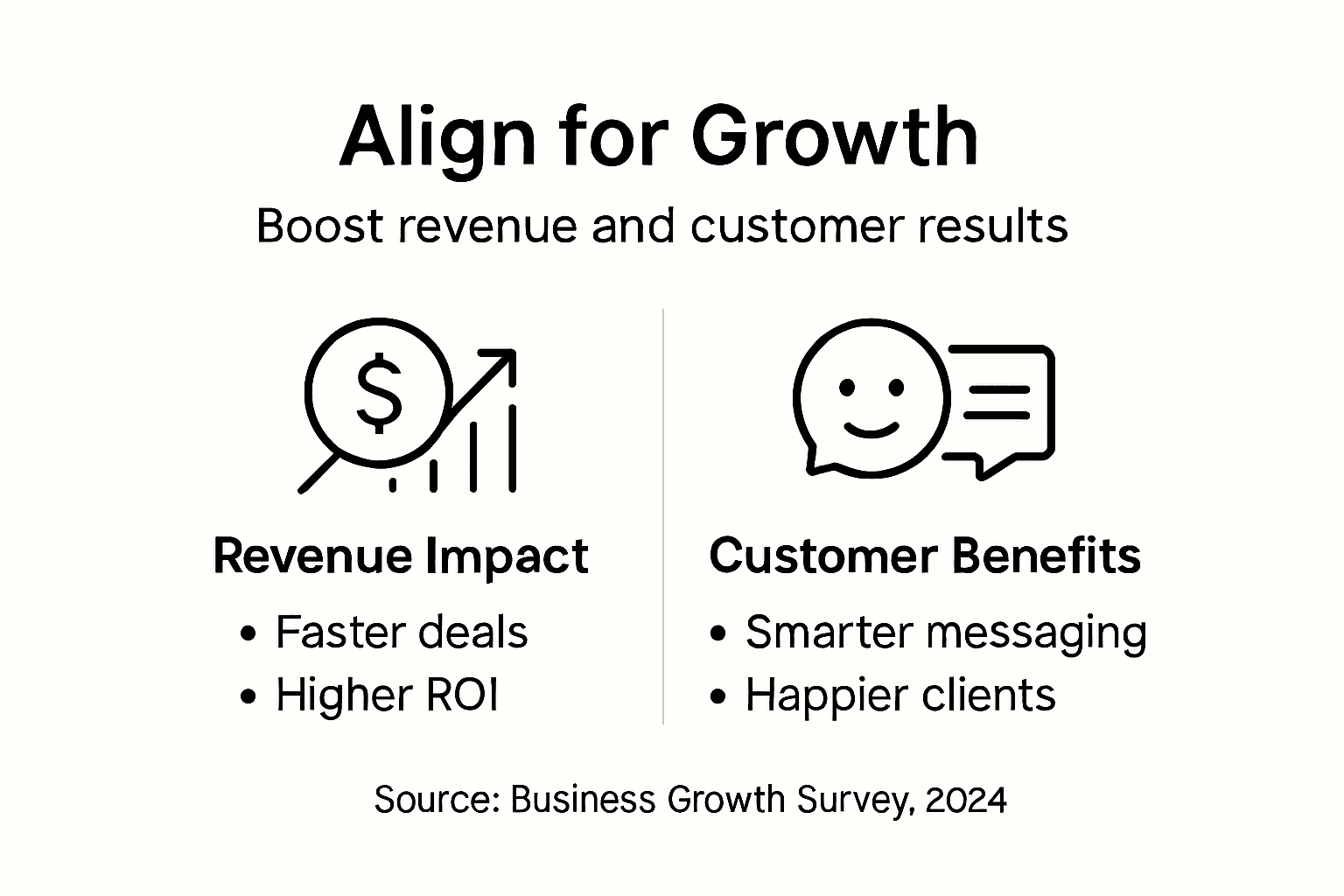
Revenue acceleration becomes possible when marketing and sales teams collaborate effectively. By creating a seamless handoff process, organizations can reduce friction in the customer acquisition journey, enabling faster decision-making and more targeted approach to potential clients.

Customer impact represents another critical dimension of alignment. When messaging, understanding of customer needs, and communication remain consistent across marketing and sales touchpoints, organizations can build more authentic and trusted relationships. This consistency helps potential customers feel understood, reducing resistance in the purchasing process and increasing the likelihood of long-term engagement.
Pro tip: Implement quarterly cross-functional workshops where marketing and sales teams analyze customer feedback and jointly develop integrated strategies for improving lead quality and conversion rates.
Key Drivers of Alignment Success
Research from Harvard Business Review reveals that successful marketing and sales alignment requires more than simple communication—it demands a comprehensive strategic approach that transforms organizational culture and operational dynamics.
The critical drivers of alignment success include:
Shared performance metrics and goals
Transparent communication protocols
Integrated technological platforms
Cross-functional leadership commitment
Consistent customer journey mapping
Mutual respect and collaborative mindset
Technological integration plays a pivotal role in breaking down traditional departmental barriers. By implementing unified customer relationship management (CRM) systems and data-sharing platforms, organizations create a single source of truth that enables real-time insights and collaborative decision-making.
Leadership commitment represents another fundamental driver of alignment success. Executives must actively model cross-functional collaboration, create incentive structures that reward team integration, and establish clear expectations for mutual accountability. When leadership demonstrates a genuine commitment to breaking down silos, teams are more likely to embrace a collaborative approach that prioritizes collective success over individual departmental achievements.
Pro tip: Develop a quarterly cross-functional performance scorecard that rewards both marketing and sales teams for collaborative outcomes, not just individual metrics.
Common Alignment Pitfalls to Avoid
Research from Harvard Business Review reveals the critical challenges that derail marketing and sales collaboration, exposing the complex dynamics that prevent effective organizational alignment.
The most significant pitfalls organizations encounter include:
Territorial attitudes and departmental defensiveness
Misaligned performance incentives
Inconsistent communication protocols
Disconnected technological infrastructure
Lack of shared customer understanding
Blame-oriented cultural dynamics
Absence of executive sponsorship
Cultural barriers represent the most insidious obstacle to successful alignment. When marketing and sales teams develop competing narratives or view each other as adversaries, they create internal friction that directly undermines organizational performance. These psychological walls can manifest through subtle communication breakdowns, passive-aggressive behaviors, and a persistent unwillingness to share critical insights.
Technological infrastructure often becomes another significant stumbling block. Organizations frequently maintain separate systems that prevent seamless data sharing, creating information silos that fragment the customer experience and reduce overall operational efficiency. Without integrated platforms that provide comprehensive visibility, teams remain fundamentally disconnected, despite best intentions.
Below is a reference table outlining common alignment pitfalls and solutions to address them:
Pitfall | Impact | Practical Solution |
Departmental defensiveness | Slows collaboration, increases conflict | Create shared incentives for both teams |
Disconnected technology | Data silos limit insight | Implement a unified CRM system |
Inconsistent communication | Leads to confusion, missed opportunities | Standardize protocols and meeting rhythms |
Lack of executive support | Change efforts stall | Involve leaders in alignment initiatives |
Pro tip: Create a cross-functional task force with representatives from both marketing and sales to diagnose and systematically address alignment barriers.
Measuring ROI and Business Outcomes
Research from Harvard Business Review highlights the critical importance of establishing comprehensive metrics that quantify marketing and sales alignment’s true business impact.
Key performance indicators for measuring alignment success include:
Revenue growth percentage
Lead conversion rates
Customer acquisition cost reduction
Sales cycle duration
Pipeline velocity
Customer lifetime value improvement
Marketing-sourced revenue contribution
Financial metrics serve as the ultimate validation of marketing and sales collaboration. By tracking holistic indicators that span both departments, organizations can demonstrate tangible value creation and justify continued investment in alignment strategies.
Companies must move beyond traditional departmental metrics to develop integrated performance frameworks. This approach requires creating shared dashboards that provide comprehensive visibility into how marketing and sales efforts collectively drive business outcomes. Sophisticated measurement strategies go beyond surface-level numbers, revealing nuanced insights about customer engagement, conversion effectiveness, and revenue generation potential.
Pro tip: Develop a quarterly cross-functional scorecard that assigns joint accountability for revenue metrics, ensuring both marketing and sales teams are measured on collaborative performance.
Unlock Growth by Aligning Your Marketing and Sales Teams
Struggling with gaps between marketing and sales that slow your business growth? This common challenge of misaligned goals and inconsistent communication costs revenue and frustrates teams. The article highlights key pain points like unclear lead handoffs, disconnected technology, and lack of shared customer insights—all obstacles that can be transformed into growth drivers with the right strategy and integration.
At Unnamed Marketing Company, we specialize in helping businesses overcome these very issues through strategic growth planning, brand alignment, and integrated execution frameworks. Our expertise in crafting seamless collaboration between marketing and sales ensures your revenue goals are unified and your customer journey is consistent. Explore our Digital Products designed to streamline your technological platforms and foster cross-department teamwork.

Take control of your organizational growth today by aligning your marketing and sales teams with expert guidance from Unnamed Marketing Company. Visit our website to discover tailored solutions that connect strategy, creativity, and performance. Start building a collaborative future that drives results and accelerates revenue now.
Frequently Asked Questions
What is marketing and sales alignment?
Marketing and sales alignment is a strategic approach where marketing and sales teams collaborate seamlessly to drive revenue and organizational growth by sharing insights, goals, and customer understanding.
Why is it important to align marketing and sales?
Aligning marketing and sales improves lead quality, shortens sales cycles, enhances customer experience, and increases overall organizational efficiency, ultimately driving revenue growth.
What are the common pitfalls to avoid when aligning marketing and sales?
Common pitfalls include departmental defensiveness, misaligned performance incentives, inconsistent communication protocols, and lack of executive support, which can hinder collaboration and effectiveness.
How can organizations measure the success of marketing and sales alignment?
Organizations can measure alignment success using key performance indicators such as revenue growth percentage, lead conversion rates, customer acquisition cost reduction, and sales cycle duration.
Recommended

Comments