


_edited.png)
Marketing Positioning Workflow for Brand Growth Success
- Feb 17
- 8 min read

Standing out in the competitive North American professional services sector demands more than just quality work. Many Canadian founders and marketing directors realize success starts with a deep understanding of their market, their audience, and what truly sets them apart. By focusing on crystal-clear market and audience insights, you can develop a strategy that drives growth and sharpens your brand’s story, creating a lasting impact in Toronto and beyond.
Table of Contents
Quick Summary
Key Point | Explanation |
1. Conduct thorough market research | Understand your audience through demographic, behavioral, and competitive analysis to drive brand positioning. |
2. Craft a compelling value proposition | Clearly communicate what makes your brand unique and why customers should choose you over competitors. |
3. Analyze the competitive landscape | Regularly assess competitors to identify positioning opportunities and customer preferences. |
4. Develop consistent brand messaging | Create unified communication that resonates across all channels to build trust and recognition. |
5. Validate findings with stakeholder feedback | Continuously collect and analyze feedback to refine your brand positioning effectively. |
Step 1: Assess current market and audience insights
To drive effective brand positioning, you need a crystal-clear understanding of your market landscape and target audience dynamics. Market analysis helps decode customer needs and provides the strategic foundation for growth.
Begin by conducting comprehensive research through multiple channels:
Demographic Investigation: Map out precise details about your target audience
Behavioral Analysis: Track purchasing patterns and engagement preferences
Competitive Intelligence: Understand how competitors are positioning themselves
Your research should dive deep into qualitative and quantitative data sources. Systematic market research techniques enable you to uncover critical insights that transform marketing strategies.
Successful positioning starts with understanding who you’re talking to and what truly matters to them.
Key research methods include customer surveys, industry reports, social media listening, and direct interviews. Focus on gathering information about:
Here’s a comparison of common research methods and their strategic business value:
Research Method | Key Strength | When to Use |
Customer Surveys | Gathers quantitative trends | Validating assumptions |
Industry Reports | Offers market-wide insights | Benchmarking and trends |
Social Media Listening | Captures real-time feedback | Spotting emerging issues |
Direct Interviews | Delivers deep qualitative data | Exploring motivations |
Customer pain points
Unmet market needs
Emerging trends in your industry
Potential growth opportunities
Use digital tools and platforms to aggregate and analyze your research data, creating a comprehensive view of your market ecosystem.
Pro tip: Always validate your research findings through multiple sources to ensure accuracy and minimize potential biases.
Step 2: Define unique value propositions for impact
Unique value propositions are the strategic foundation that separates your brand from competitors and directly communicates your distinctive market promise. Your goal is to craft a compelling narrative that instantly tells potential customers why they should choose your brand over all others.
To develop a powerful value proposition, break down your approach into critical components:
Customer Targeting: Identify your most valuable audience segments
Problem Identification: Understand specific challenges your customers face
Solution Differentiation: Highlight what makes your solution unique
Quantifiable Benefits: Demonstrate measurable outcomes and advantages
Your value proposition must answer three fundamental questions: Who are you serving? What specific problem are you solving? Why are you the best solution? Strategic value communication requires deep understanding of customer needs and precise articulation of your competitive advantages.
A remarkable value proposition turns casual observers into committed customers.
Key steps in crafting your value proposition include:
Conduct thorough customer research
Map out your competitive landscape
Distill your unique strengths
Create a clear, concise statement
Test and refine your messaging
Focus on creating a value proposition that is specific, memorable, and directly addresses the most pressing needs of your target market.

Pro tip: Validate your value proposition through direct customer feedback and iterative testing to ensure maximum resonance and impact.
Step 3: Map competitive landscape and differentiation
Competitive aggressiveness and complexity are critical factors in developing a strategic market positioning that sets your brand apart. Understanding your competitive landscape means going beyond surface-level comparisons to uncover deep insights about how you can uniquely serve your target market.
Your competitive mapping process should focus on several key dimensions:
Market Positioning: Analyze where competitors currently stand
Capability Assessment: Identify strengths and weaknesses in the market
Customer Perception: Understand how competitors are viewed by clients
Value Gap Identification: Spot opportunities for meaningful differentiation
Differentiation strategies require a systematic approach to creating unique value that resonates with your target audience. This means looking beyond product features to explore deeper ways of standing out:
Examine competitor offerings
Identify unmet customer needs
Develop unique solution approaches
Create distinctive brand messaging
Validate your differentiation strategy
True competitive advantage comes from understanding what customers truly value.
Successful differentiation is not about being different for the sake of being different. It’s about finding meaningful ways to solve customer problems more effectively than anyone else in your market.
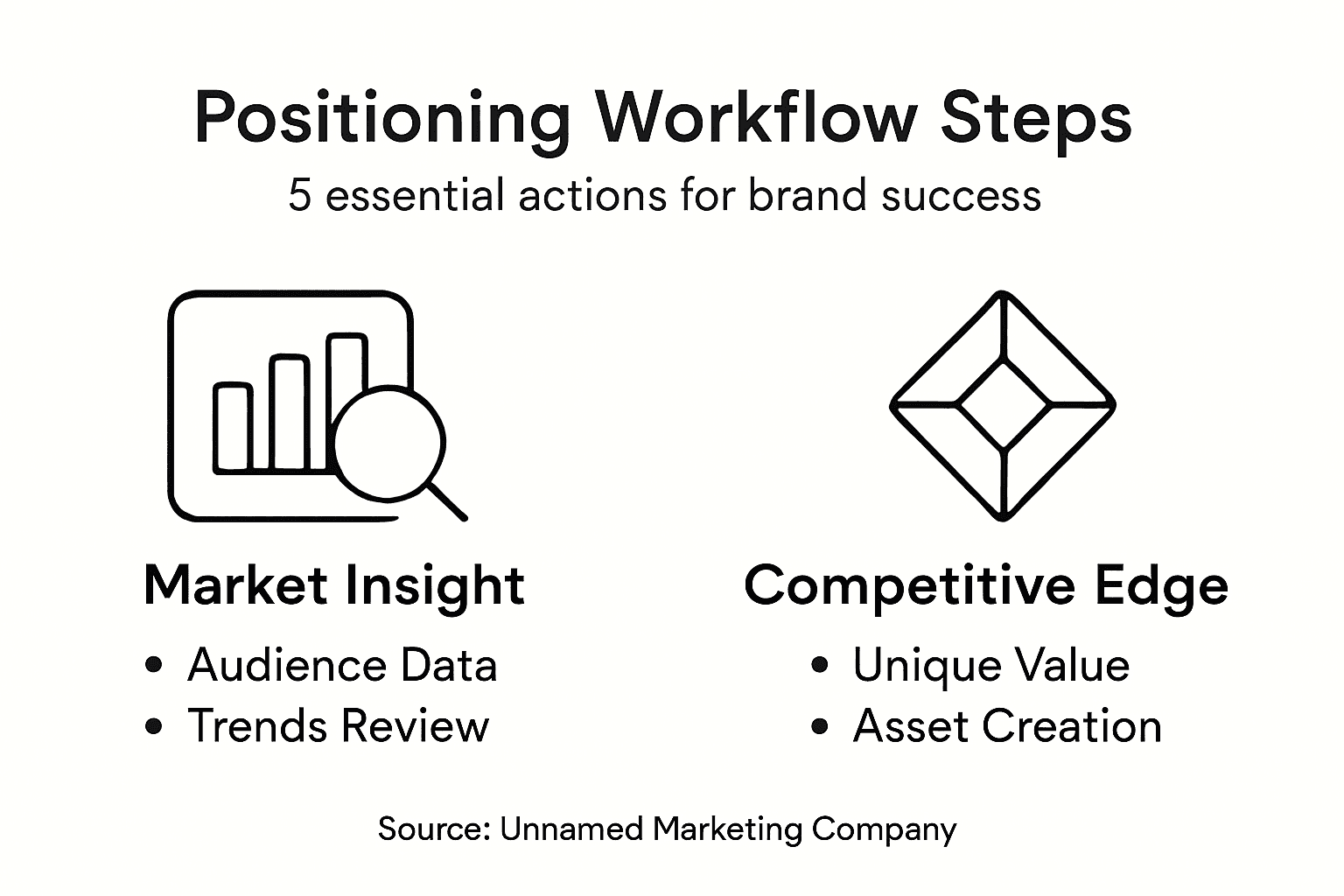
Pro tip: Conduct regular competitive analysis updates every six months to stay ahead of market shifts and emerging competitors.
Step 4: Develop consistent messaging and positioning assets
Consistent branding strategies are the cornerstone of creating a memorable and trustworthy brand identity that resonates across all marketing channels. Your goal is to craft a unified narrative that speaks with one clear, compelling voice no matter where customers encounter your brand.
Your messaging asset development should focus on several critical components:
Brand Voice Guide: Define tone, language, and communication style
Visual Identity Standards: Create comprehensive design guidelines
Messaging Framework: Develop core narratives and key communication points
Channel-Specific Adaptations: Customize messaging for different platforms
Brand identity creation requires meticulous attention to detail and a strategic approach to presenting your unique value. This means developing assets that work together seamlessly:
Document your brand’s core values
Create a comprehensive style guide
Develop template libraries
Design flexible communication frameworks
Establish review and approval processes
Consistency transforms random interactions into a cohesive brand experience.
Successful positioning assets tell a unified story that builds trust, recognition, and emotional connection with your target audience. Every piece of communication should feel like it comes from the same confident, authentic brand.
The table below summarizes core positioning asset types and their main purpose:
Asset Type | Primary Purpose | Ensures Consistency Through |
Brand Voice Guide | Defines verbal expression | Tone and language alignment |
Visual Identity Standards | Unifies visual presentation | Logos, colors, and typography |
Messaging Framework | Clarifies core brand messaging | Key story points and phrasing |
Template Libraries | Streamlines content development | Reusable design and layout tools |
Pro tip: Create a centralized brand asset library that all team members can easily access and reference to maintain messaging consistency.
Step 5: Validate positioning through stakeholder feedback
Stakeholder engagement strategies are critical for transforming your brand positioning from an internal concept to a validated market strategy. By systematically collecting and analyzing feedback from key stakeholders, you can refine your positioning to ensure maximum resonance and impact.
Your stakeholder validation process should encompass multiple perspectives:
Customer Insights: Gather direct feedback from target audience
Industry Expert Evaluation: Seek professional perspective
Internal Team Assessment: Validate from within your organization
Competitive Benchmark Review: Compare against market standards
Strategic validation approaches require a structured methodology to collect meaningful input:
Design comprehensive feedback surveys
Conduct one-on-one interviews
Host focus group discussions
Analyze quantitative and qualitative data
Iterate positioning based on insights
Authentic feedback transforms positioning from a hypothesis to a validated strategy.
Successful validation means creating a feedback loop that continuously refines your brand’s market approach. Your goal is to understand how different stakeholders perceive your positioning and identify opportunities for improvement.
Pro tip: Implement a rolling feedback mechanism that allows for continuous positioning refinement rather than treating validation as a one-time event.
Elevate Your Brand Growth with Strategic Market Positioning
Marketing positioning demands a deep understanding of your audience pain points and the ability to clearly define your unique value proposition. This article highlighted challenges such as decoding market complexities and creating consistent messaging. Do you want to overcome competitive pressures and build a memorable brand that truly resonates? Our strategic approach at Unnamed Marketing Company combines data-driven insight with creative execution to help you clarify direction and grow with intention.
Discover how our Digital Products | Unnamed Marketing Company empower you to craft compelling positioning assets and communicate your brand promise effectively.

Take control of your brand story today by partnering with a consultancy that understands the critical balance between strategy, creativity, and performance. Visit Unnamed Marketing Company now and start turning your brand positioning into a growth success.
Frequently Asked Questions
How can I assess my current market and audience insights for effective marketing positioning?
To assess your current market and audience insights, conduct comprehensive research using channels like customer surveys and social media listening. Focus on understanding customer pain points and behavior patterns, and analyze competitive intelligence to create a strategic foundation for your brand growth. Start gathering data now to refine your messaging over the next 30 days.
What are unique value propositions, and how can I develop one for my brand?
Unique value propositions define why potential customers should choose your brand over competitors. To create yours, identify your target audience, understand their challenges, and highlight how your solution uniquely addresses their needs. Outline key benefits clearly, and aim to develop a compelling narrative in the next 14 days.
What are the key dimensions I should consider in my competitive landscape analysis?
Key dimensions to consider in your competitive landscape analysis include market positioning, capability assessment, customer perception, and value gap identification. Examine where competitors stand, evaluate their strengths and weaknesses, and identify unmet customer needs to differentiate your brand effectively. Aim to document this analysis within the next month.
How can I ensure consistent messaging across all my branding assets?
To ensure consistent messaging, create a brand voice guide, establish visual identity standards, and develop a messaging framework. Document these elements and create a centralized library for team access to maintain alignment across all communication. Begin this process by drafting your brand voice guide in the next two weeks.
What methods can I use to validate my brand positioning with stakeholders?
You can validate your brand positioning by collecting feedback through surveys, one-on-one interviews, and focus group discussions. Ensure you analyze both quantitative and qualitative data to iterate on your positioning strategy effectively. Initiate this validation process within 30 days to refine your positioning based on real insights.
How do I identify customer pain points and unmet market needs?
Identify customer pain points and unmet market needs by conducting direct interviews and analyzing feedback from customer surveys. Utilize qualitative data to understand their challenges deeply and derive actionable insights. Start engaging customers actively to gather this information within the next 45 days.
Recommended

Comments